Art Basel Paris 2026 Was Cut Short. Here's What We Saw.
Despite closing two days early, there was no shortage of art to contemplate at Art Basel Paris. Beneath the glass roof of the Grand Palais, celebrated masters, contemporary provocations, and emerging artists offered a compelling portrait of art today. Writer Dan Latif considers the art, then asks the audience.
Art Basel Paris 2026: Contemporary Galleries and Modern Masters
Taste of Paris, the Saut Hermès, the Tour Auto and, these days, Art Basel Paris: the nave of the Grand Palais continues to host one prestigious event after another. Beneath its vast glass roof and pale green iron framework, 211 galleries from 41 countries and territories share the space for this fifth edition of the fair, amid a maze of booths, monumental sculptures and paintings, some worth several million euros.
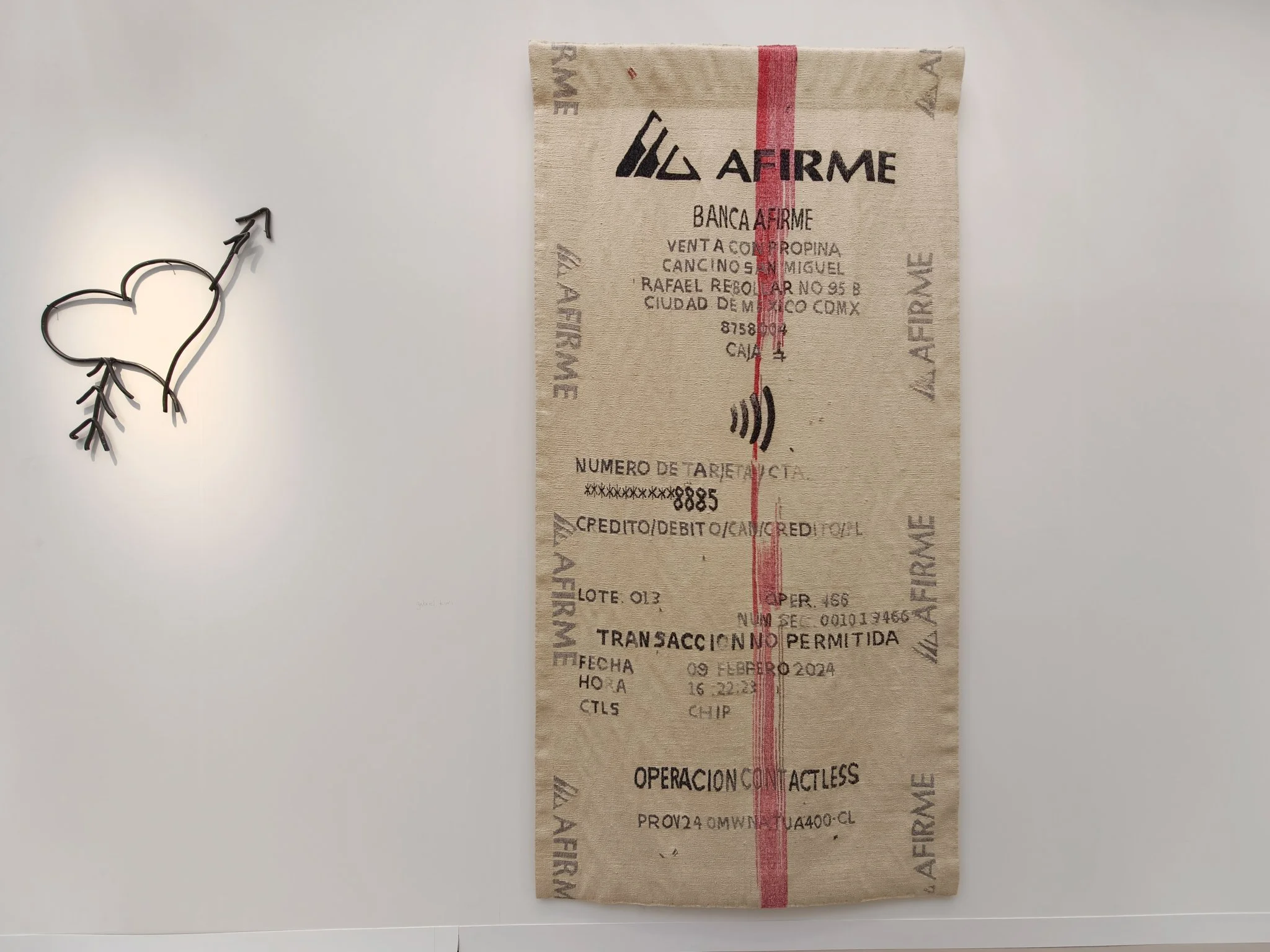
Gabriel Kuri, untitled (afirme), 2025 at Kurimanzutto. Hand-woven wool gobelin, 278 × 140 cm. Also visible: Petrit Halilaj, Abetare (Arrow Heart) (2026). Image: Dan Latif.
At this modern and contemporary art fair there is a little bit of everything, in every conceivable size and material. From cash receipts enlarged to the scale of a tapestry (including one reproducing a Mexican bank receipt recording a declined transaction, Gabriel Kuri’s untitled (afirme)), to an installation of blue and brown Venetian blinds arranged in a suspended geometric composition, Haegue Yang’s Tidal Cobalt Winged Concave.
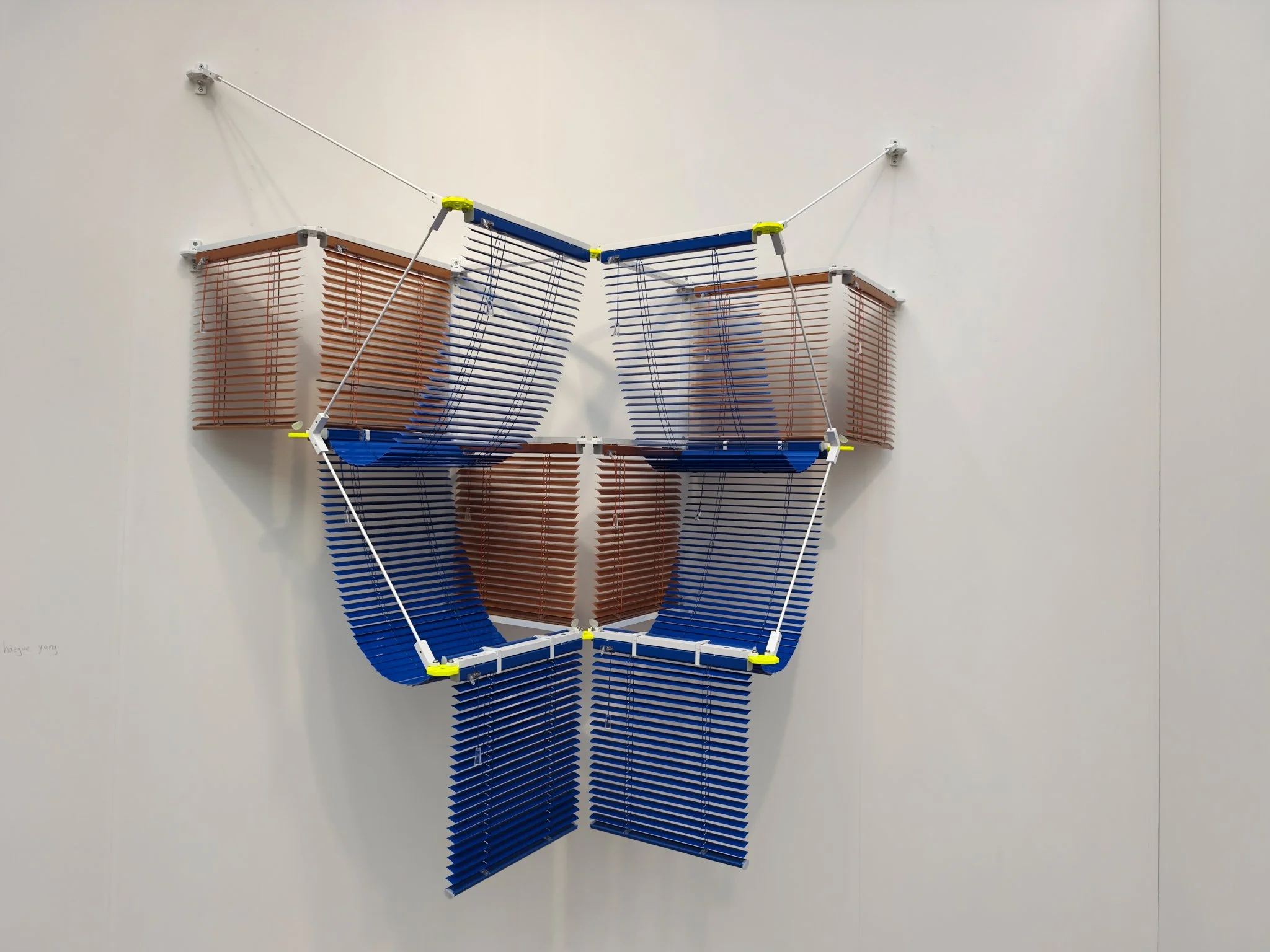
Haegue Yang, Tidal Cobalt Winged Concave, 2026 at Kurimanzutto. Aluminum Venetian blinds and powder-coated aluminum and stainless steel structure, 186 × 201 × 69 cm. Image: Dan Latif.
Upstairs, visitors encounter more emerging and mid-sized galleries, sometimes lesser-known talents, more experimental proposals and intimate formats. Downstairs, on the ground floor, are also concentrated the "big players", here to sell: Gagosian, Hauser & Wirth, Perrotin and David Zwirner, names that resonate throughout the international art market. Among the artists announced by Perrotin for this edition are Takashi Murakami, Sophie Calle, Maurizio Cattelan and Jean-Michel Othoniel.
Other galleries, including Van de Weghe, Nahmad Contemporary, Landau Fine Art and Sprüth Magers, remind us of the importance of the great masters at a fair otherwise largely devoted to contemporary creation. At Van de Weghe, Andy Warhol is represented by Shadows; at Nahmad Contemporary, Jean Dubuffet by La Route d'Étaples; and at Landau Fine Art, Fernand Léger by L'Équipe au repos. Works by Joan Miró, notably Femme rêvant de l'évasion, and Pablo Picasso, including Les Dormeurs, also feature among the memorable references encountered on this journey through twentieth-century art. Names that naturally attract collectors' attention and reflect the ongoing dialogue between historical works, modernism and the most recent artistic explorations.
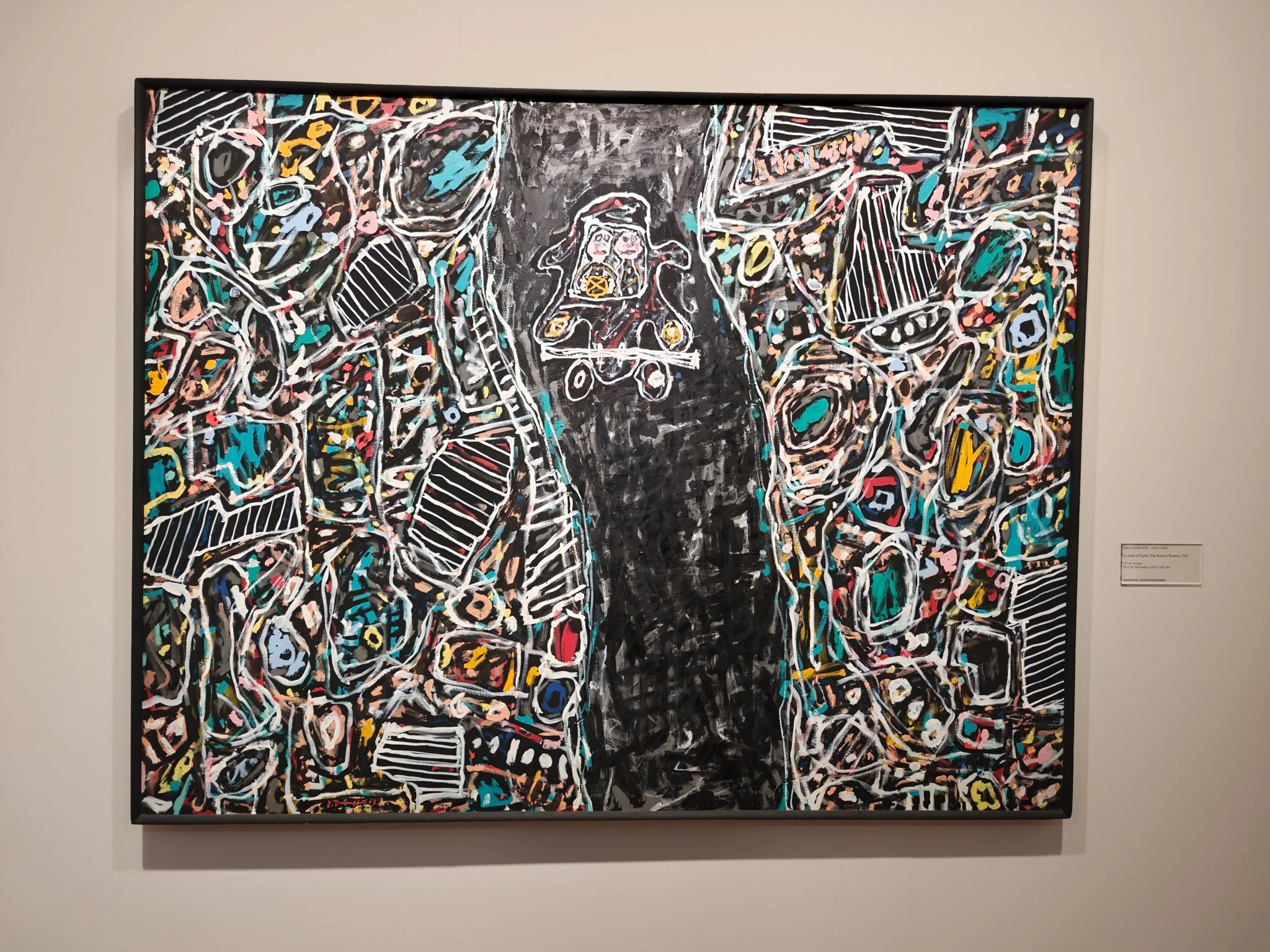
Jean Dubuffet, La route d’Étaples, 1963 at Nahmad Contemporary. Oil on canvas, 150 × 195 cm. Image: Dan Latif.
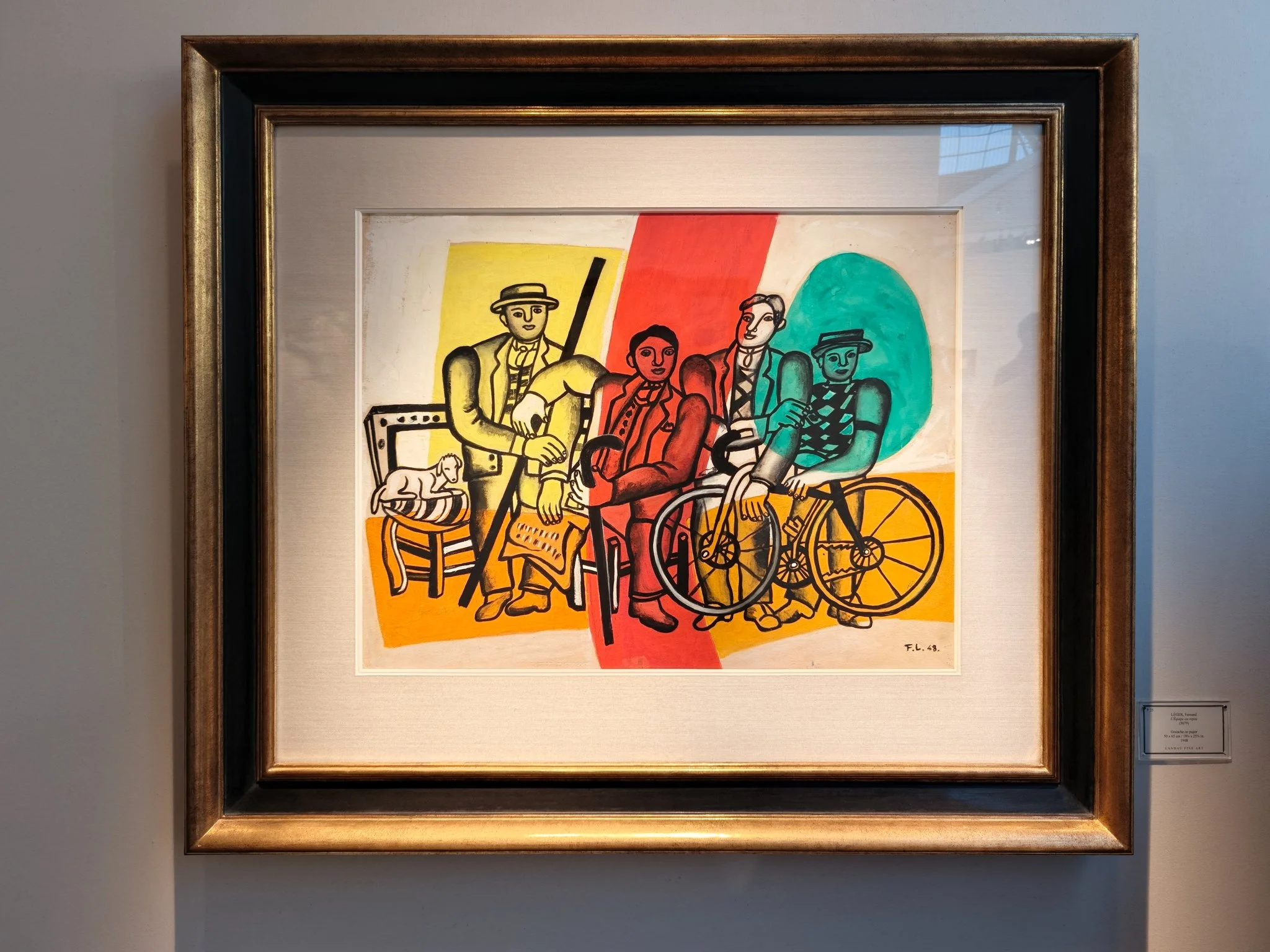
Fernand Léger, L’Équipe au repos, 1948 at Landau Fine Art. Gouache on paper, 50 × 65 cm. Image: Dan Latif.
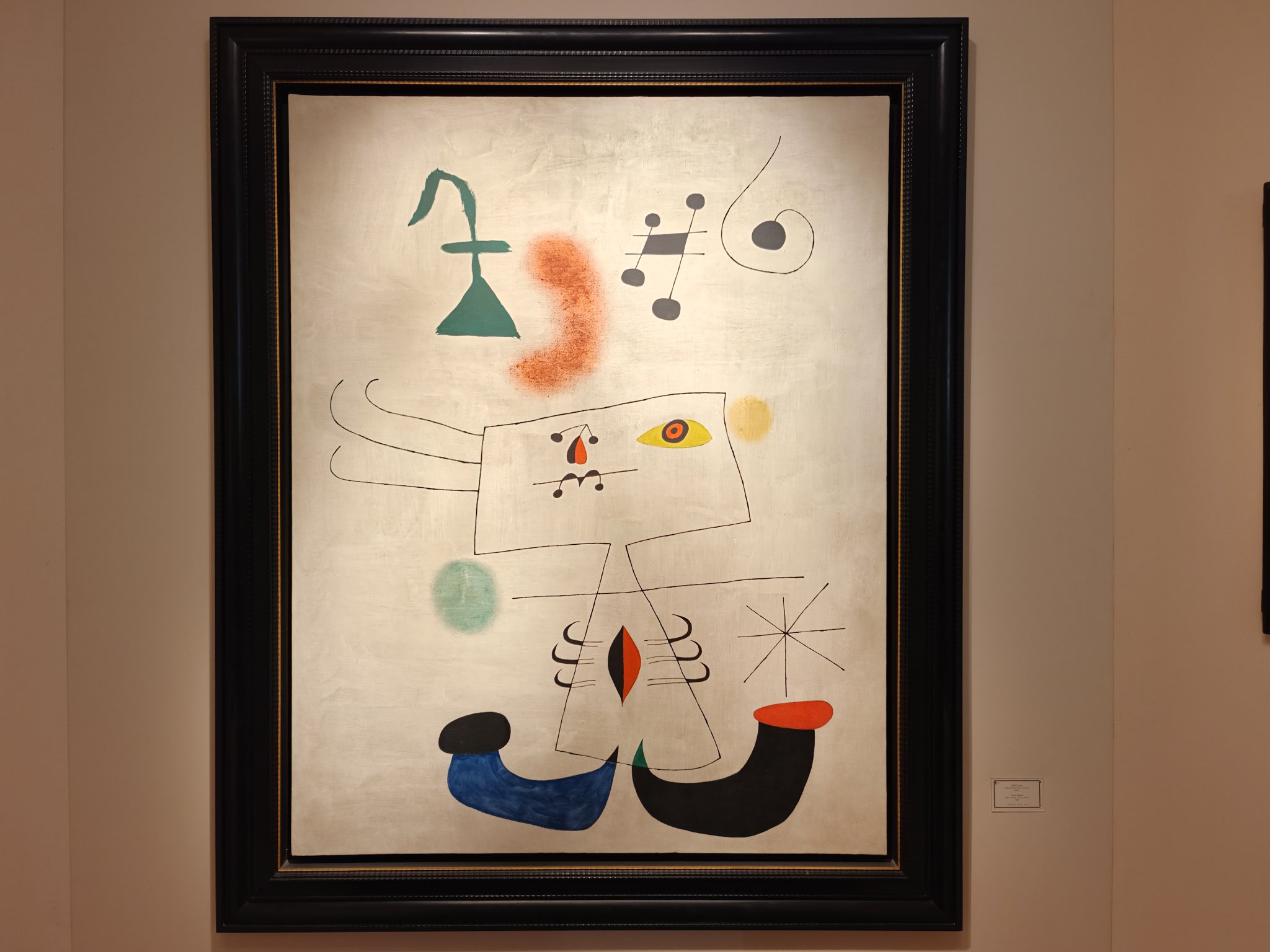
Joan Miró, Femme rêvant de l’évasion, 1945 at Landau Fine Art. Oil on canvas, 146 × 114 cm. Image: Dan Latif.
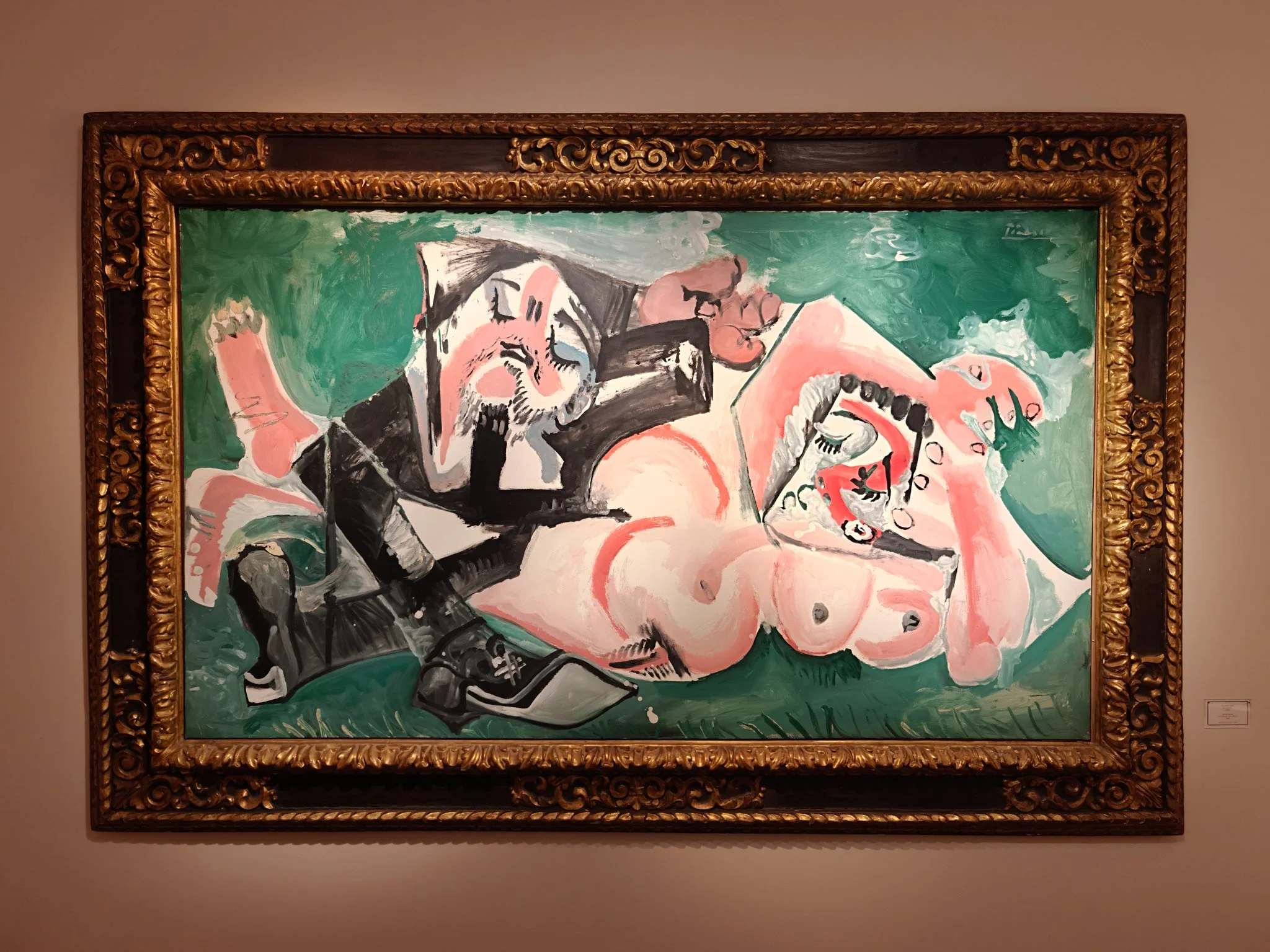
Pablo Picasso, Les Dormeurs, 1965 at Landau Fine Art. Oil on canvas, 114 × 195 cm. Image: Dan Latif.
Nina Childress's Catherine Deneuve Portrait at Art Basel Paris
Yet amid these prestigious signatures, one enormous contemporary canvas draws a particularly dense crowd. Against an incandescent red background, the face of a very young Catherine Deneuve emerges in an explosion of yellow, orange and pink. This is Catherine D. (grosse tête) (2026), a 260 × 210 centimetre painting by Nina Childress, presented by Art : Concept. The Franco-American artist, who heads a studio at the Beaux-Arts de Paris, gives the portrait a spectacular presence. Her blonde hair, almost luminous, seems to catch the light from every direction. The blue-green eyes, delicate features and striking color contrasts turn this young Deneuve into a radiant apparition, somewhere between a cinematic image and a popular icon.
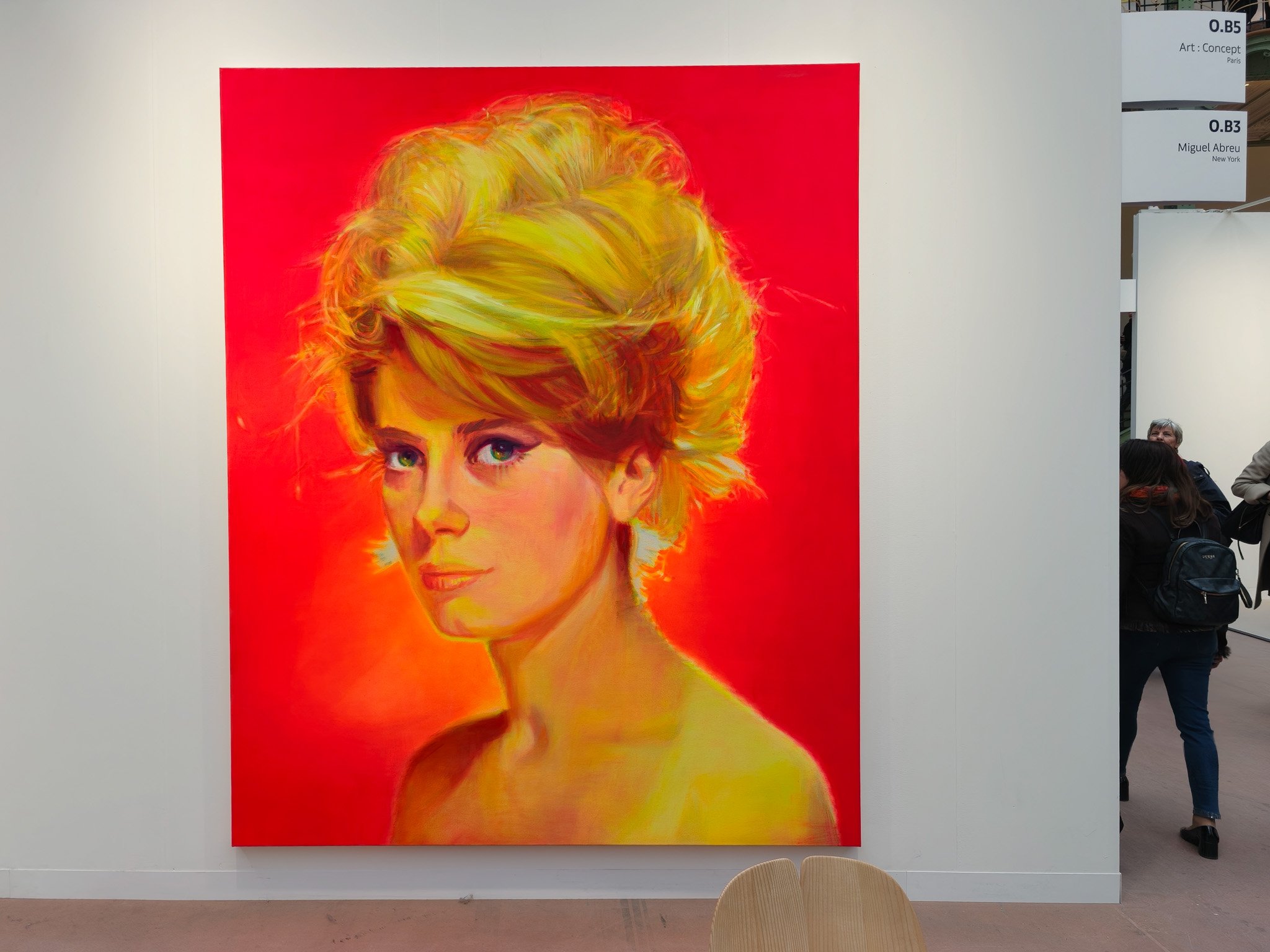
Nina Childress, Catherine D. (grosse tête), 2026 at Art : Concept. Oil on canvas, 260 × 210 cm. Image: Dan Latif.
Jeff, an artist and interior designer from New York, spends a long time contemplating this Catherine Deneuve. "The light is fantastic. The red makes her look like a star, not just a pretty girl. It looks like sunshine," he enthuses. He likes the painting so much that he begins to imagine it hanging in his own home. "I wish I had a wall big enough to hang it on." Of course, one would need a space capable of accommodating such a monumental canvas.
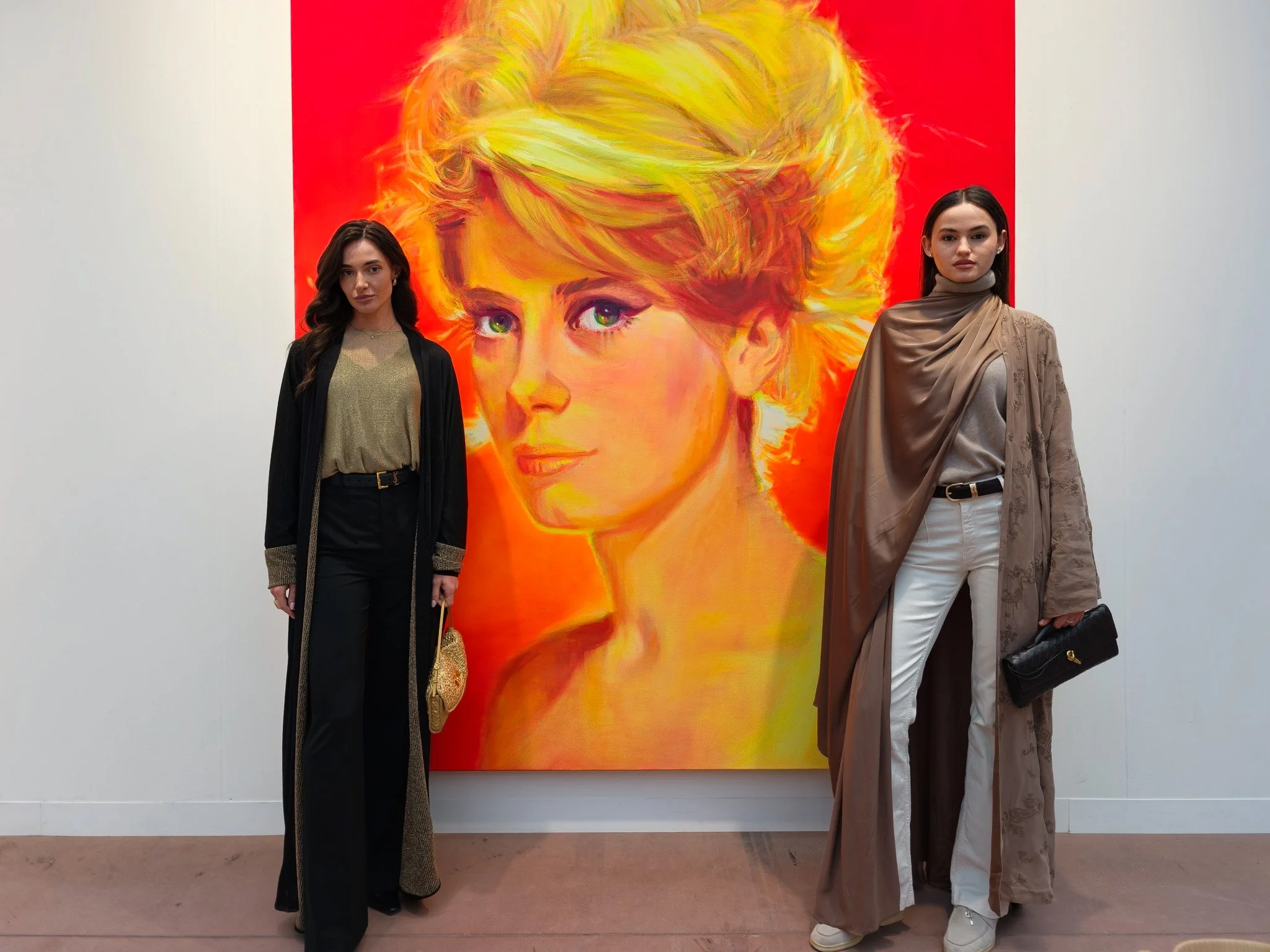
Nina Childress, Catherine D. (grosse tête), 2026 at Art : Concept. Oil on canvas, 260 × 210 cm. Image: Dan Latif.
Anastasia and Olga also stop in front of the portrait, immediately searching for the best angle to capture their encounter with the young Deneuve. The former works in the fashion industry and is also a model; the latter is a creative director and fashion model. They are struck by the effects of light, the reflections behind the hair and the impressive dimensions of the work. Anastasia has come in search of "inspiration, an exchange of energy and anything made by hand, because that is the new luxury." An approach to creativity in which the human touch and craftsmanship take on particular significance.
Among the crowds gathered beneath the nave, there are also young school students. Olympia and Mélissa, both in their penultimate year of secondary school, already know they want to study at Sciences Po. They have just taken a selfie in front of Nina Childress's painting, particularly admiring "the effects of light in her hair, which give her an aura." The two girls enjoy visiting Art Basel Paris as though it were "a stroll, where you move from one exhibition to another." What appeals to them, they explain, is the freedom to move from one world to the next, discovering different atmospheres without having to follow a predetermined route.
The painting also appeals to visitors more familiar with the art scene, including the singer Oli, who takes the time to stop in front of this Deneuve, which he finds "magnificent and soothing." When asked about the idea of owning a work of this scale, he can easily imagine it in his living room. Another perspective on painting, bringing these monumental works back to a very practical question: what would it be like to live with them at home?
Contemporary Artworks and Installations at Art Basel Paris 2026
Elsewhere, an immense silver surface, entirely covered with small metallic fragments, catches the light, its cut-out elements appearing to tremble in the air currents. At Gladstone, Rirkrit Tiravanija paints a caricature-like figure bent over a laboratory cluttered with scientific instruments, microscopes, multicolored test tubes and a computer, all set against an assemblage of pages from The New York Times. The scene resembles an absurd laboratory, its bold black outlines standing out against the newspaper's densely packed columns.
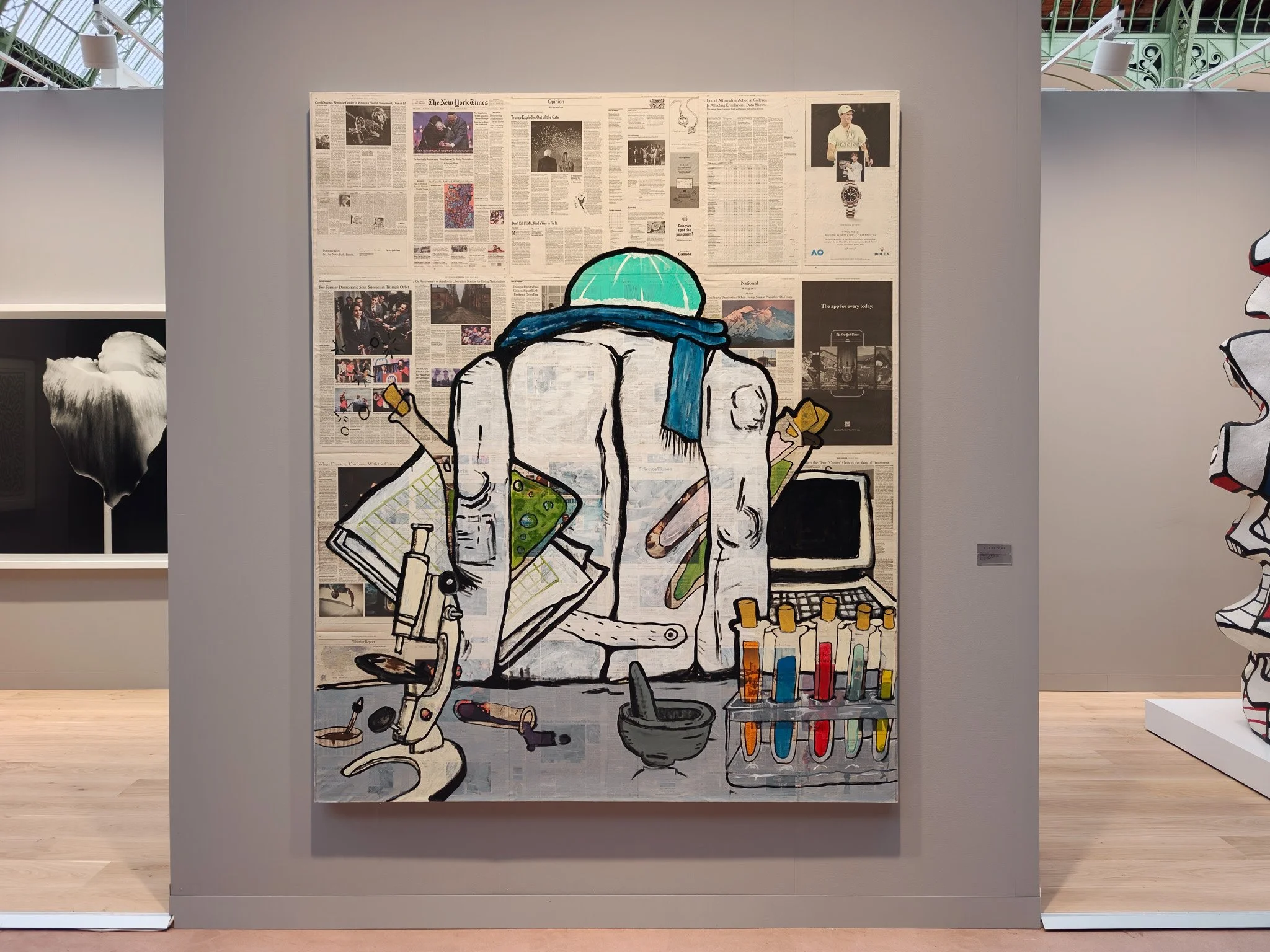
Rirkrit Tiravanija, untitled 2025 (the intellects take leave, fig. five) (new york times, january 28, 2025), 2025 at Gladstone. Oil on newspaper on linen, 222 × 183 × 6 cm. Image: Dan Latif.
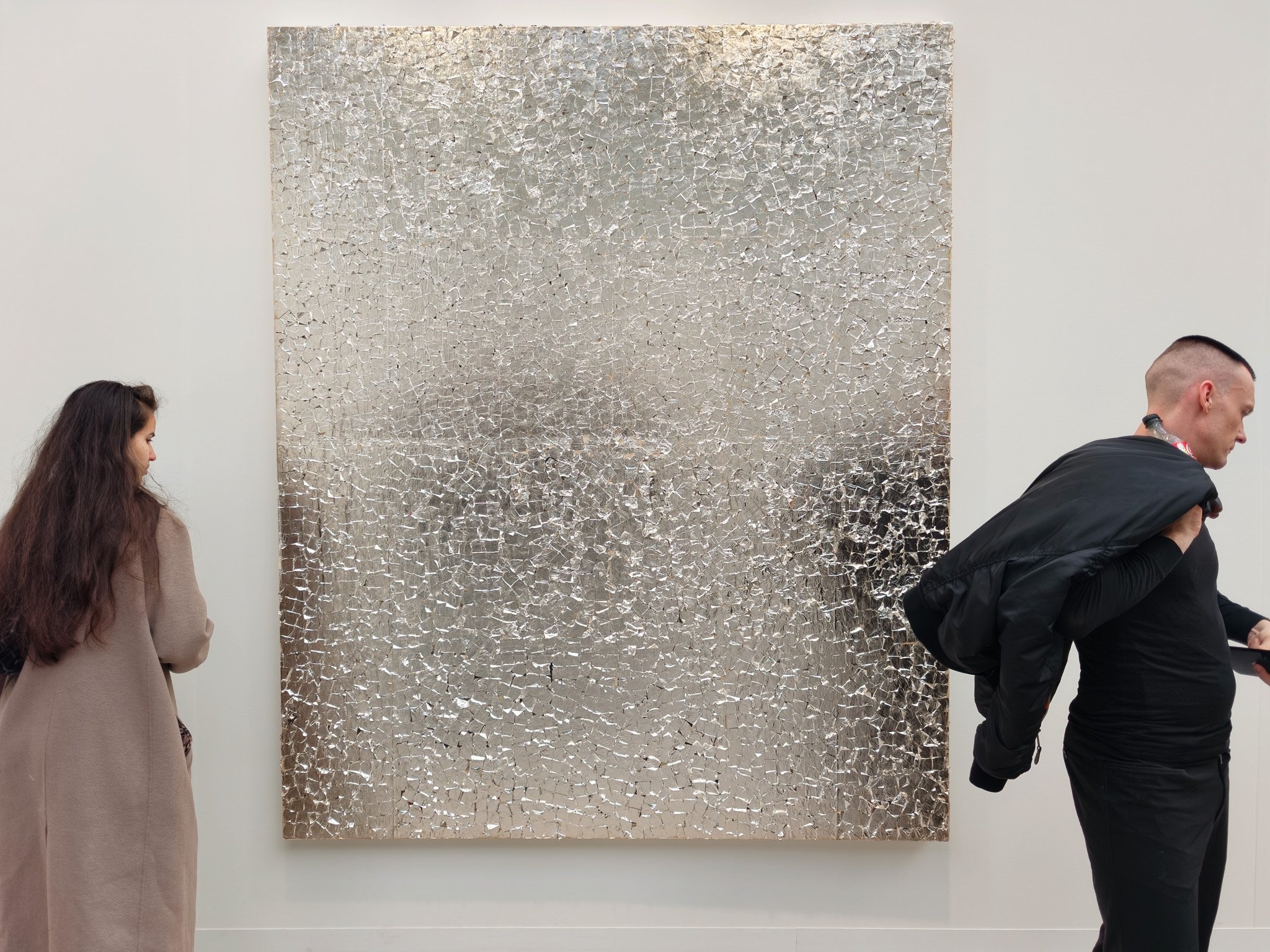
Rirkrit Tiravanija, untitled 2026 (new york times 23 january, 2025), 2026 at Kurimanzutto. Silver leaf on newspaper on handcrafted paper, 225 × 184 × 9.5 cm. Image: Dan Latif.
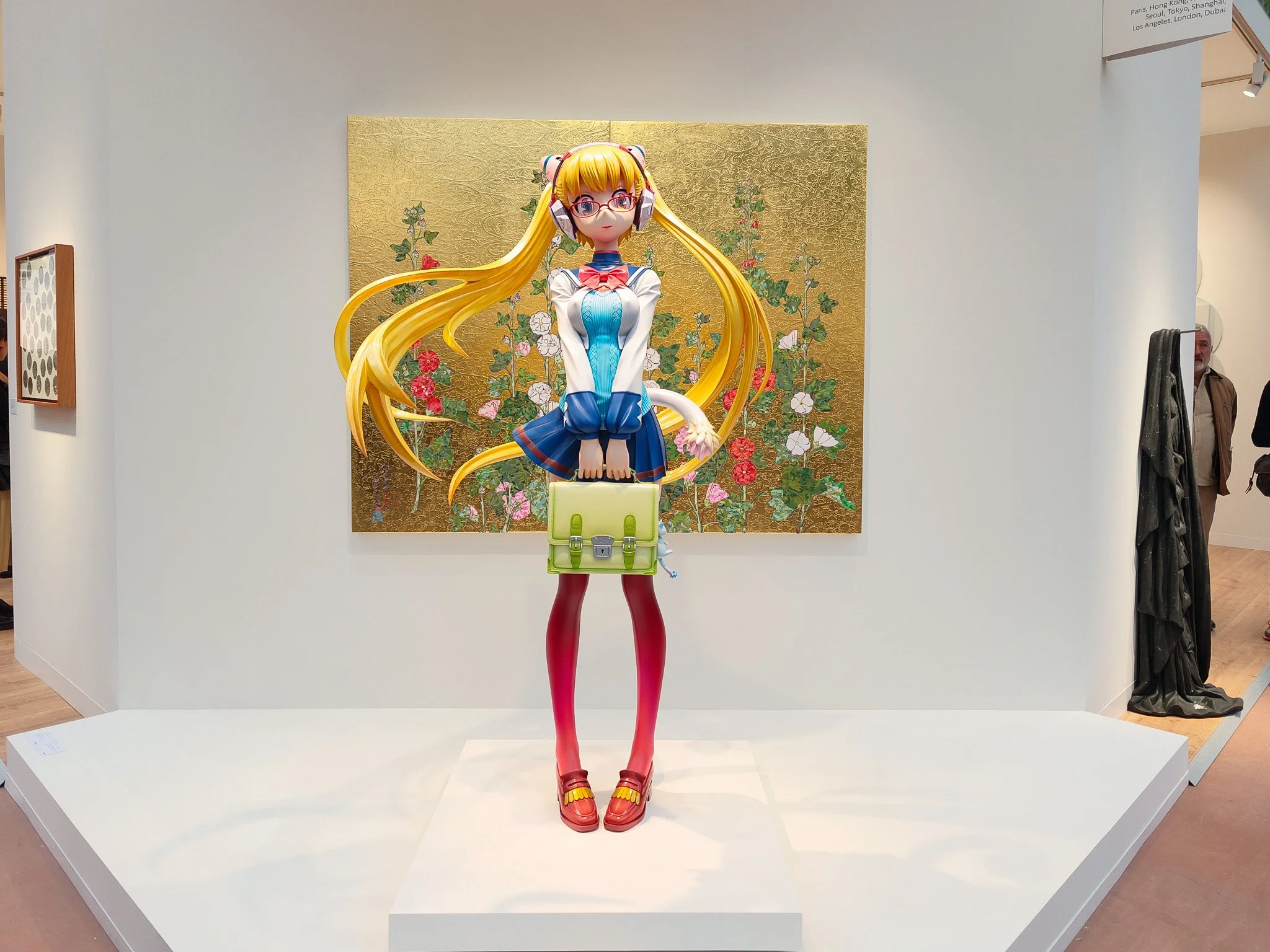
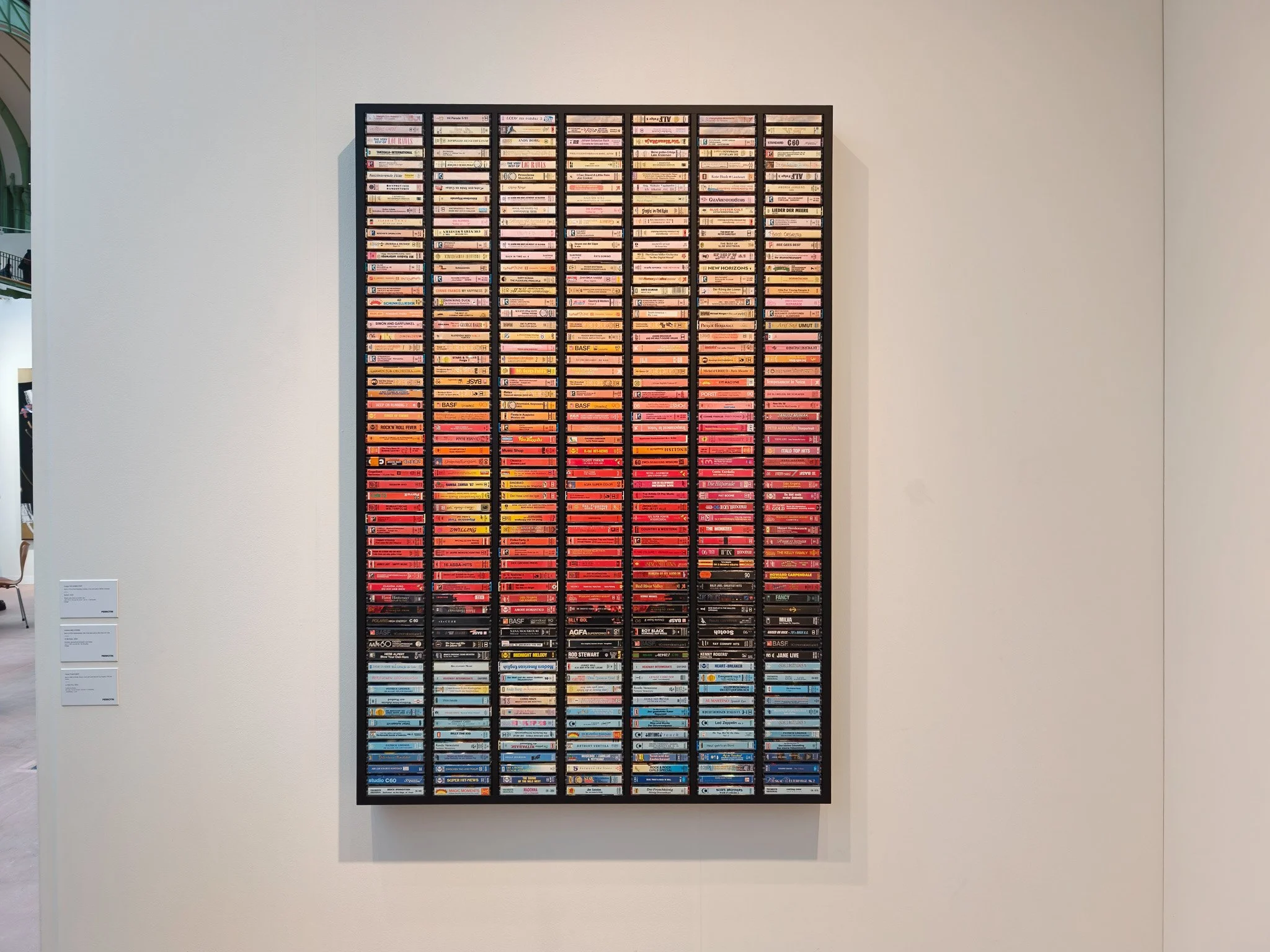
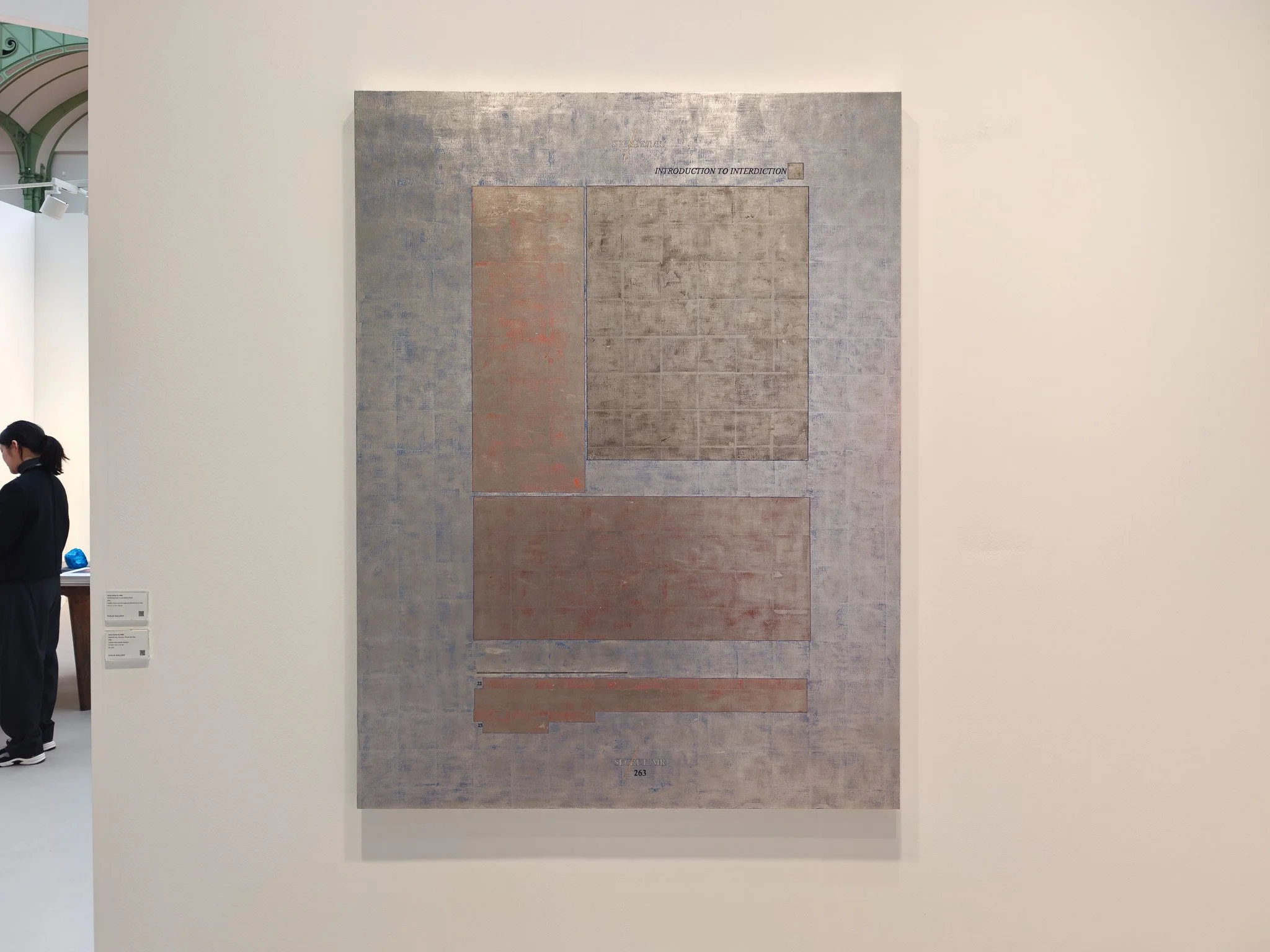
The most ordinary materials are thus repurposed, enlarged and assembled, sometimes beyond recognition. At Perrotin, a life-size sculpture by Japanese artist Takashi Murakami, School Girl Ko², depicts a young girl with long blonde pigtails, inspired by manga aesthetics, standing in front of a painting with a golden floral background. Nearby, Gregor Hildebrandt's wall composition Sunset brings together hundreds of audio cassettes arranged in a gradient of colors. A few booths further along, Jenny Holzer presents Introduction to Interdiction (2024) at Kukje Gallery, a canvas combining metallic leaf, paint and barely decipherable text, as though fragments of information had been buried within the material itself.
A little further along, the eye is drawn to Spotted Bettie (2018), an oil on canvas by Tursic & Mille, presented by Alfonso Artiaco. The painting takes on the appearance of an old black-and-white photograph, depicting a woman in a domestic interior beside a television set from another era. Thick strokes of pink, blue, green and yellow paint interrupt the image, spreading across the body like fragments of material applied over the surface. The work resembles a collage, although it is in fact a painting, blurring the boundaries between found imagery, reproduction and painterly intervention.
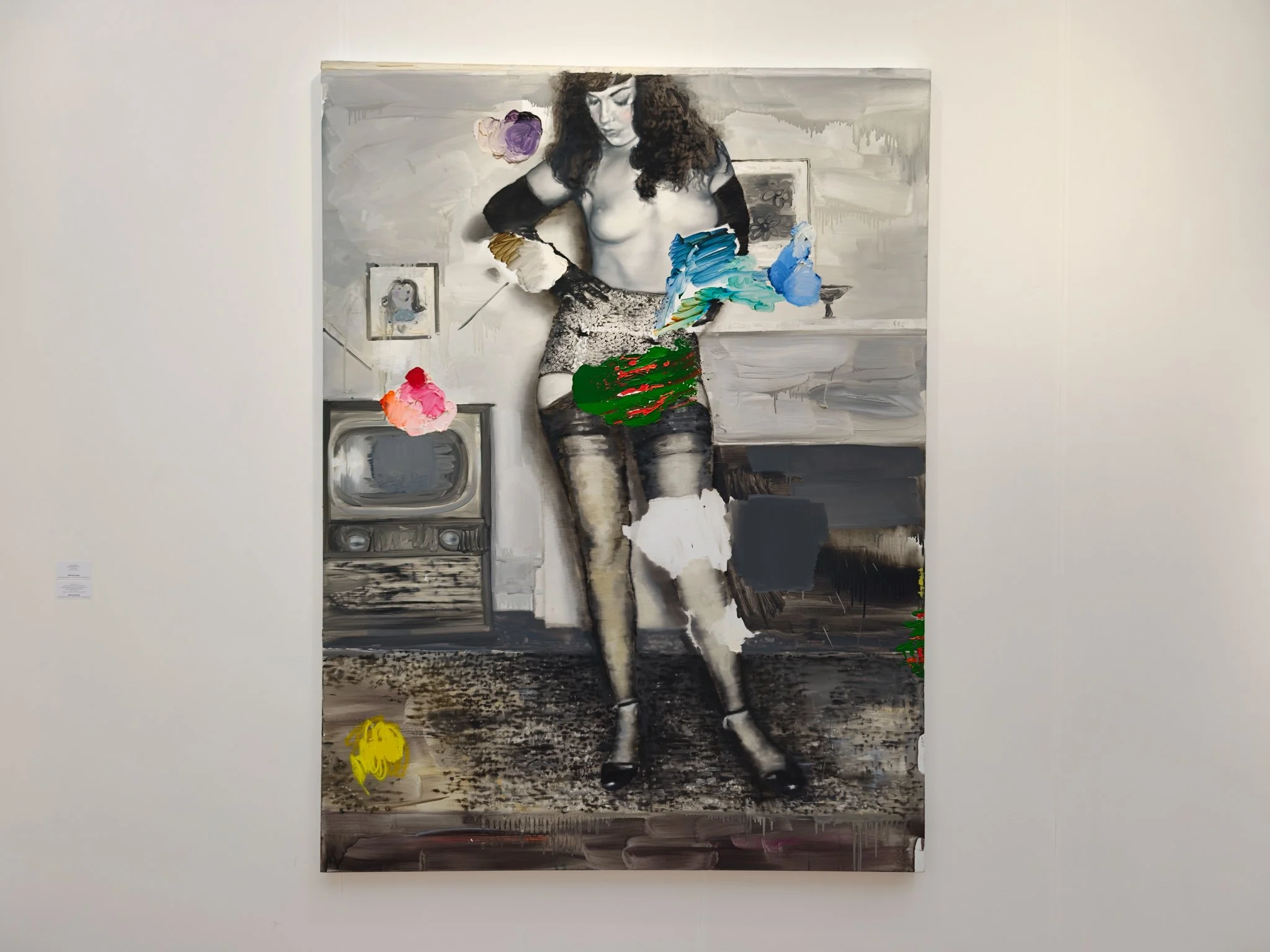
Tursic & Mille, Spotted Bettie, 2018 at Alfonso Artiaco. Oil on canvas, 220 × 165 × 5 cm. Image: Dan Latif.
As the visit continues, the formats become increasingly imposing. At Mai 36 Galerie, from Zurich, a photograph by Thomas Ruff entitled 22h 24m/-20° (1992) stretches across 260 × 188 centimetres. Part of his Sterne series, the work draws the eye into the darkness of space, where a field of stars emerges against a black background. For this series, the artist drew on the photographic archives of the European Southern Observatory, giving a new dimension to these scientific images of the sky. The scale of the print and the precision of the points of light almost create the impression of looking through a window onto the cosmos.
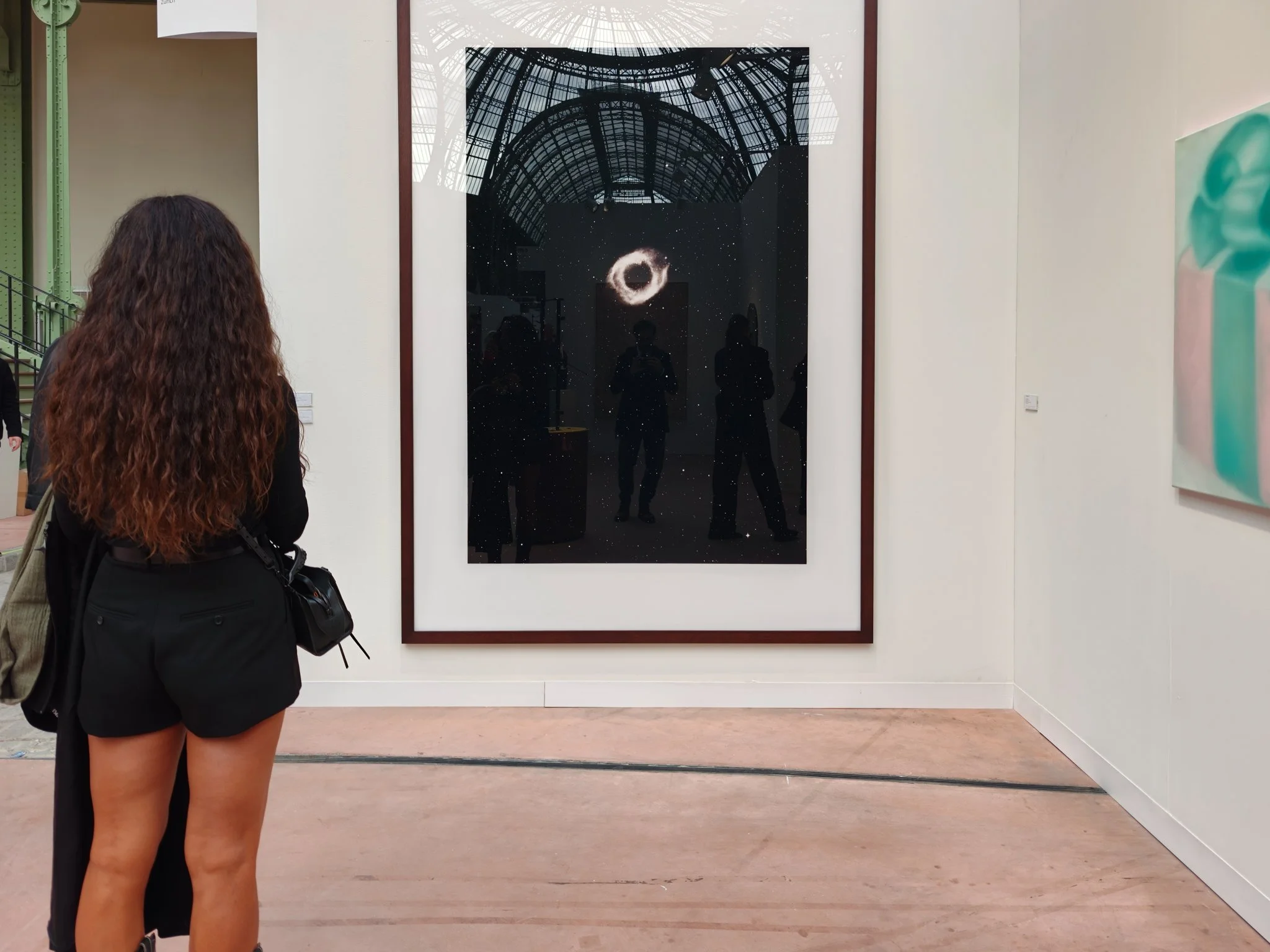
Thomas Ruff, 22h 24m/−20°, 1992 at Mai 36 Galerie. Chromogenic print, Diasec face mounting, 260 × 188 × 4 cm (framed). Image: Dan Latif.
Just a few steps away, an entirely different world emerges with Christo's 28 Barrels Structure (1968), presented by Gió Marconi. Twenty-eight industrial barrels, originally used for products including lubricating oils, form a pyramid of metal cylinders whose red, yellow, blue, green and white ends still bear their inscriptions and signs of wear. The Italian words "Olio Lubrificante" recall their former purpose. On the wall, a preparatory drawing reproduces the geometric arrangement of the barrels. The work possesses that particular force of industrial objects transformed into sculpture, without attempting to erase their history entirely.
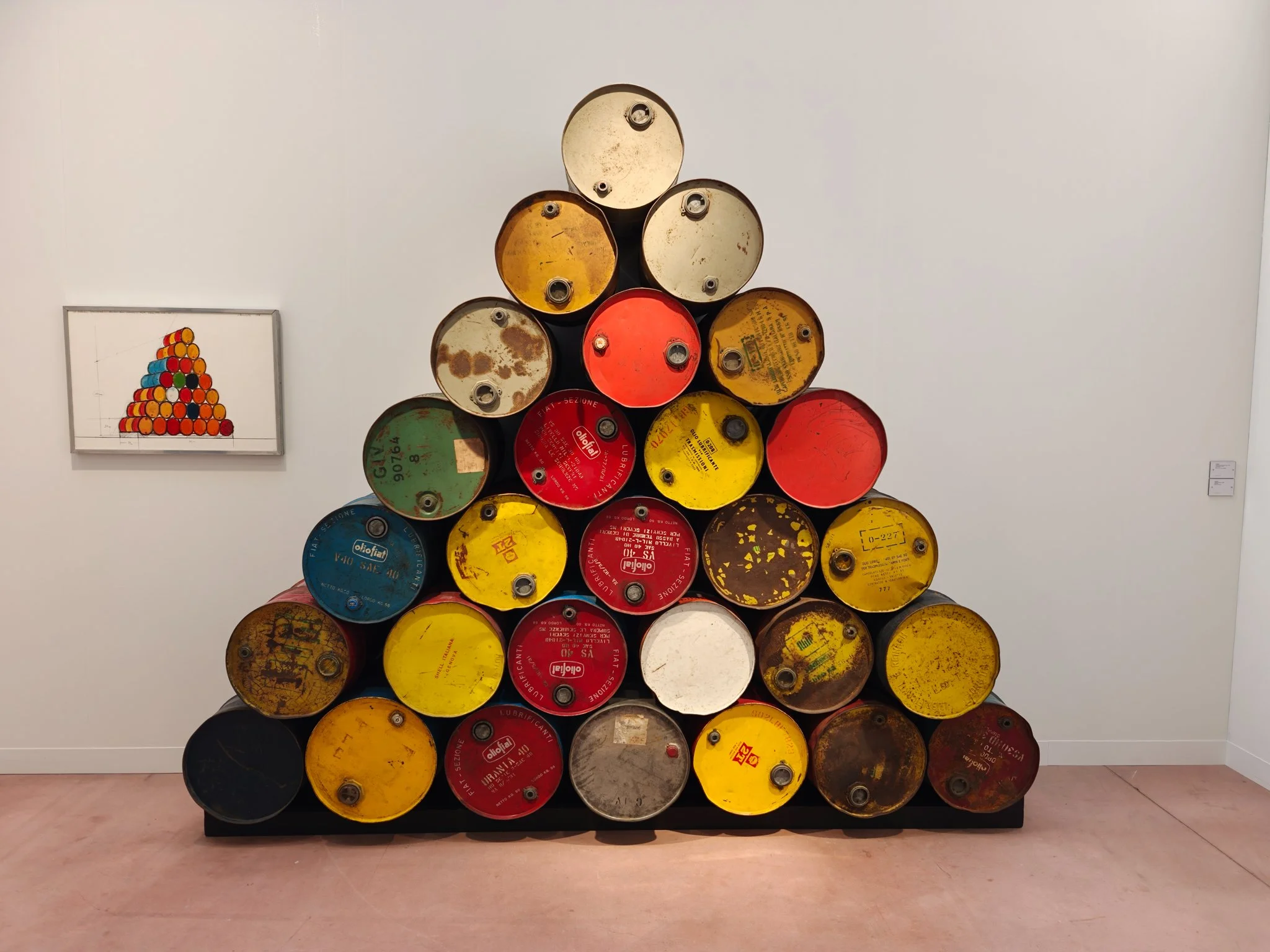
Christo, 28 Barrels Structure, 1968 at Gió Marconi. Twenty-eight barrels, 265 × 275 × 68 cm. Image: Dan Latif.
When Words Become Art: Jenny Holzer, Ed Ruscha, and Monica Bonvicini
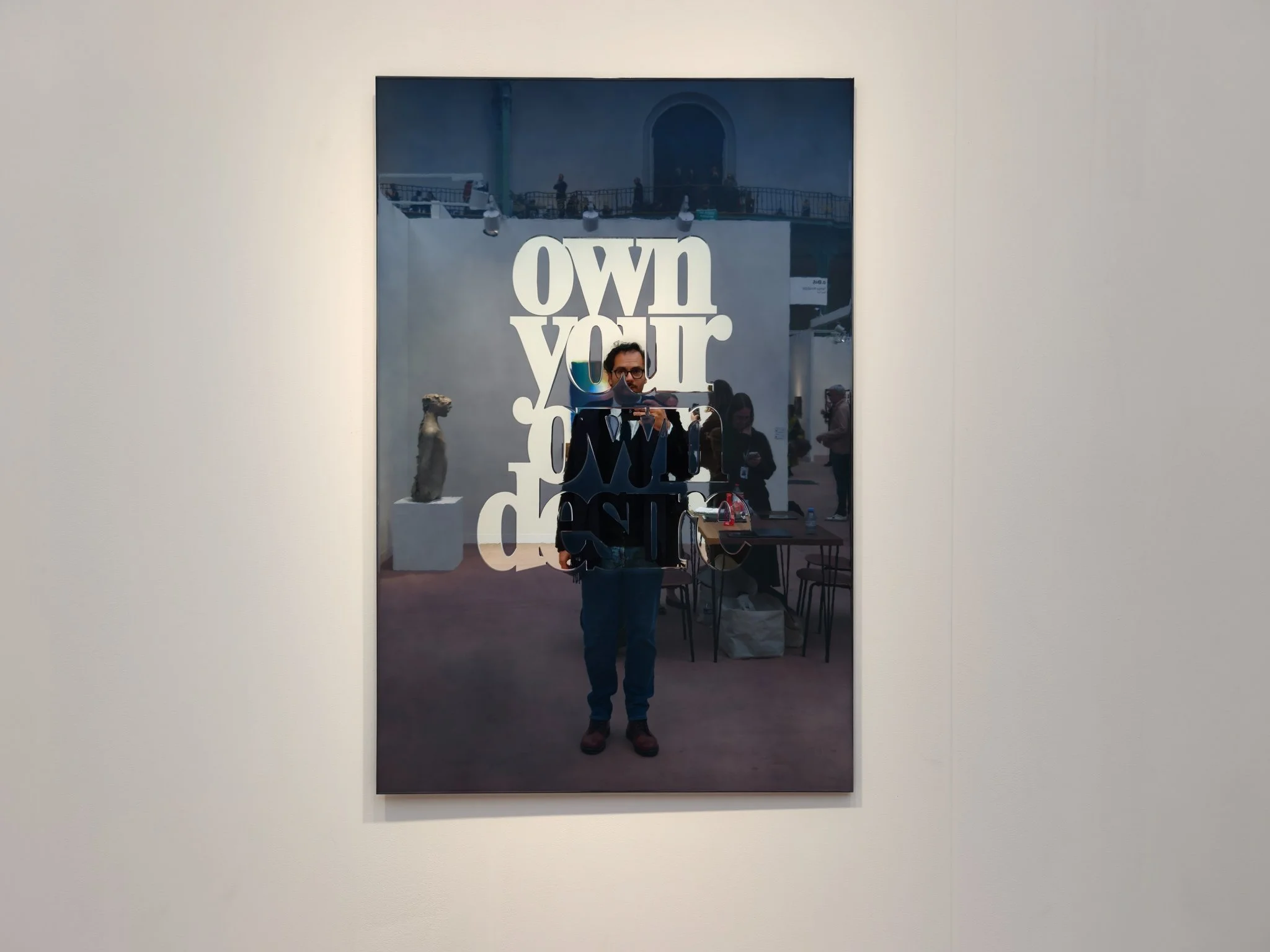
Monica Bonvicini, Your Desire, 2026 at Tanya Bonakdar Gallery. Lacquer, mirror and aluminum, two components, 150 × 100 × 1.9 cm. Image: Dan Latif.
Words, indeed, occupy a prominent place in this edition. Paintings become vehicles for maxims, slogans, declarations and more personal messages. At Tanya Bonakdar Gallery, Monica Bonvicini plays with reflections and commands in Your Desire (2026), where the words "Own Your Own Desire" appear on a dark, reflective surface, inviting viewers to take possession of their own desires. Elsewhere, "Politique" appears backwards, as does "Arc-en-ciel", or "Rainbow", written in reversed illuminated letters. At Luhring Augustine, Ragnar Kjartansson's illuminated work Dope & Corruption (2017) even seems to amuse the gallery's team. At Vedovi Gallery, Ed Ruscha makes an appearance with Suspension, while Magnetic extends this presence of words reduced to just a handful of letters, yet charged with meaning.
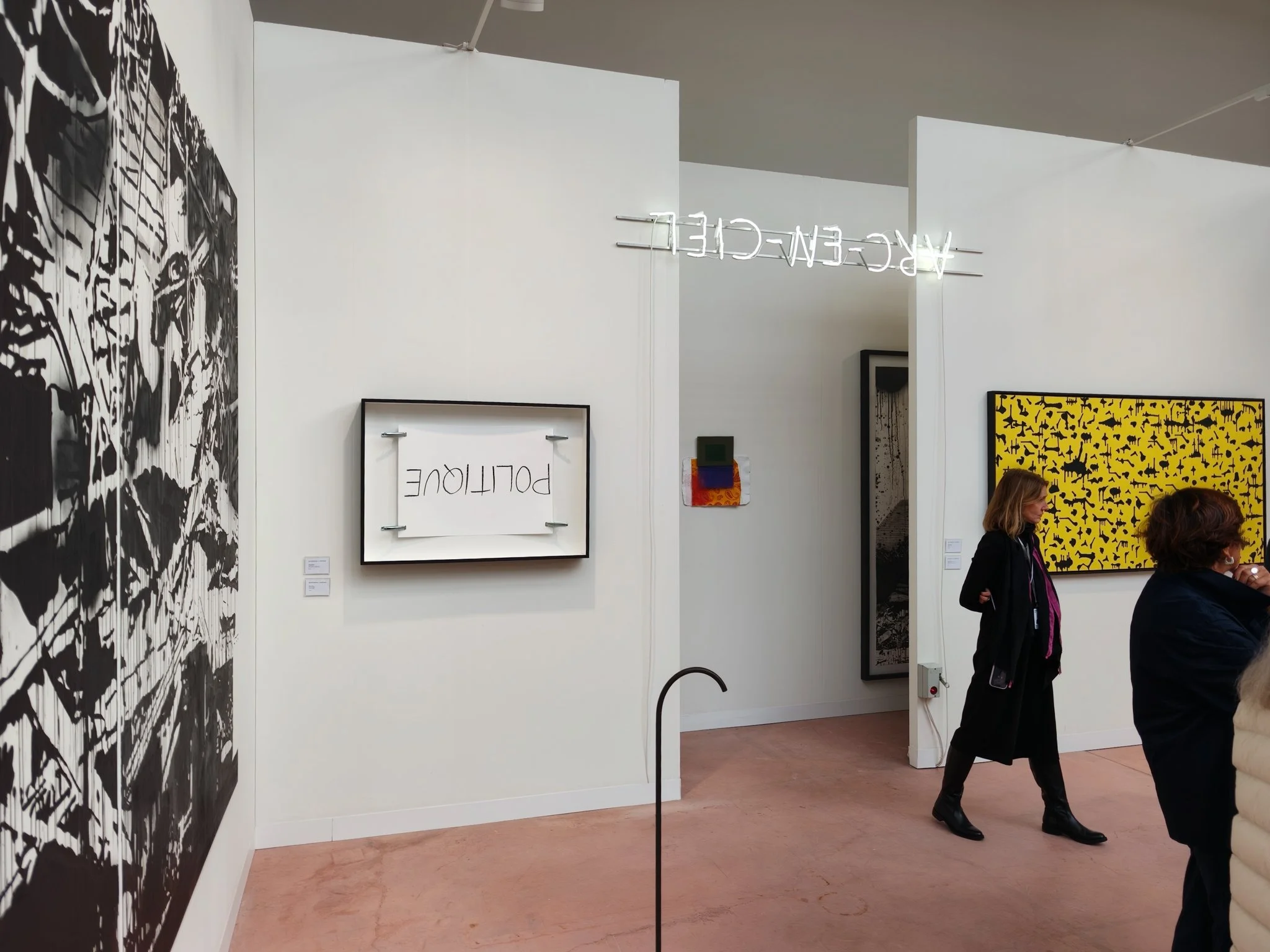
Marcello Maloberti, ARC EN CIEL, 2026 at Galleria Raffaella Cortese. Neon. Image: Dan Latif.
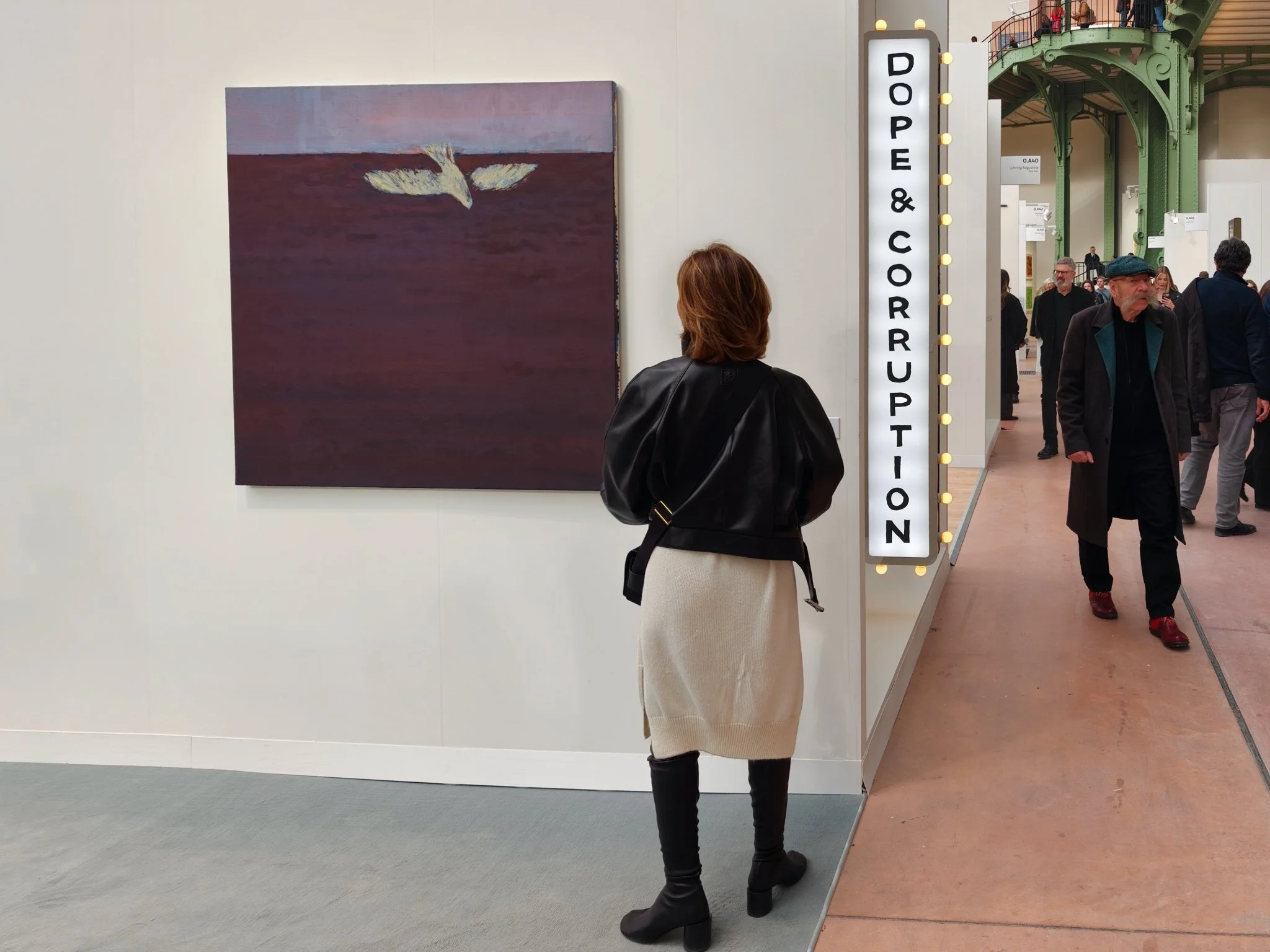
Ragnar Kjartansson, Dope & Corruption, 2017 at Luhring Augustine. Polished stainless steel, electrical components and LED light, 232 × 50 × 10 cm. Image: Dan Latif.
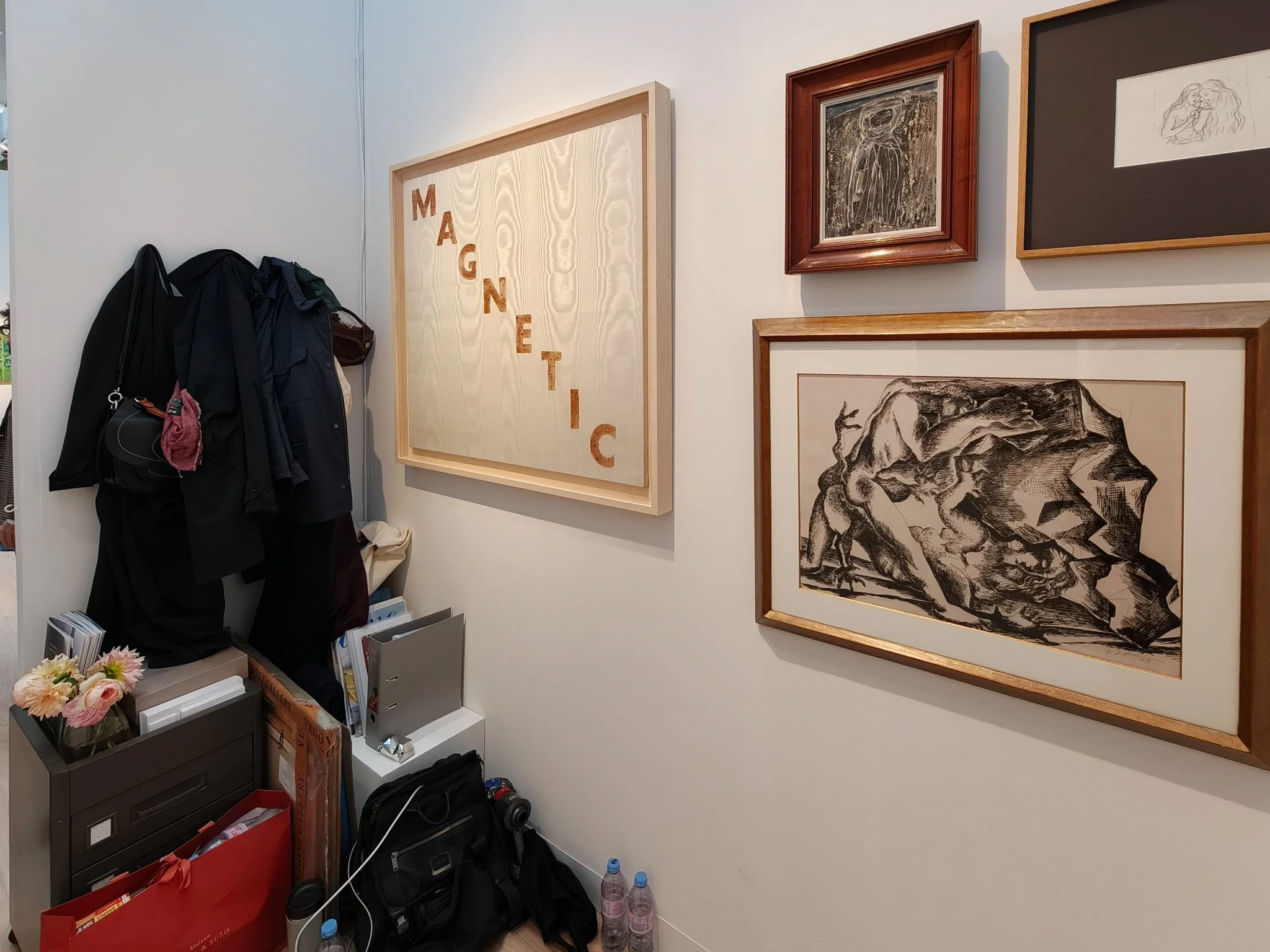
Ed Ruscha, Magnetic, 1974 at Vedovi Gallery. Blueberry juice on moiré, 91.1 × 101.6 cm. Image: Dan Latif.
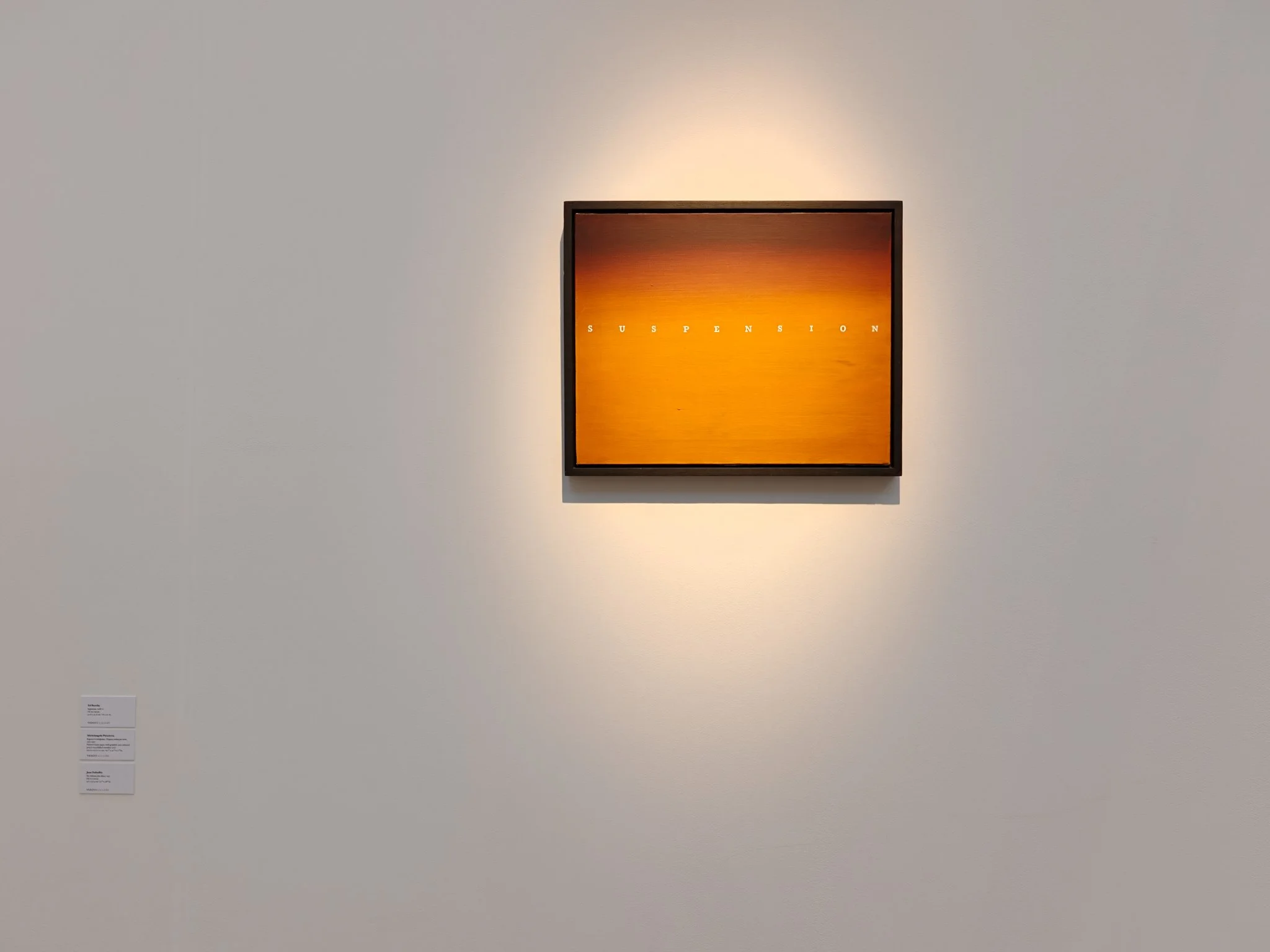
Ed Ruscha, Suspension at Vedovi Gallery. Image: Dan Latif.
Further on, an installation of mismatched golden letters proclaims Famous Last Words, those memorable final words one might wish to leave to posterity. At 47 Canal, Antoine Catala reveals a more intimate message with Mist Drawing (Je T'aime ♡) (2026). Inside a transparent Plexiglas structure, water condensation gradually reveals a declaration of love, fragile and almost ephemeral. Through these works, text is no longer simply meant to be read: it becomes material, light, reflection and, at times, a presence that eventually disappears.
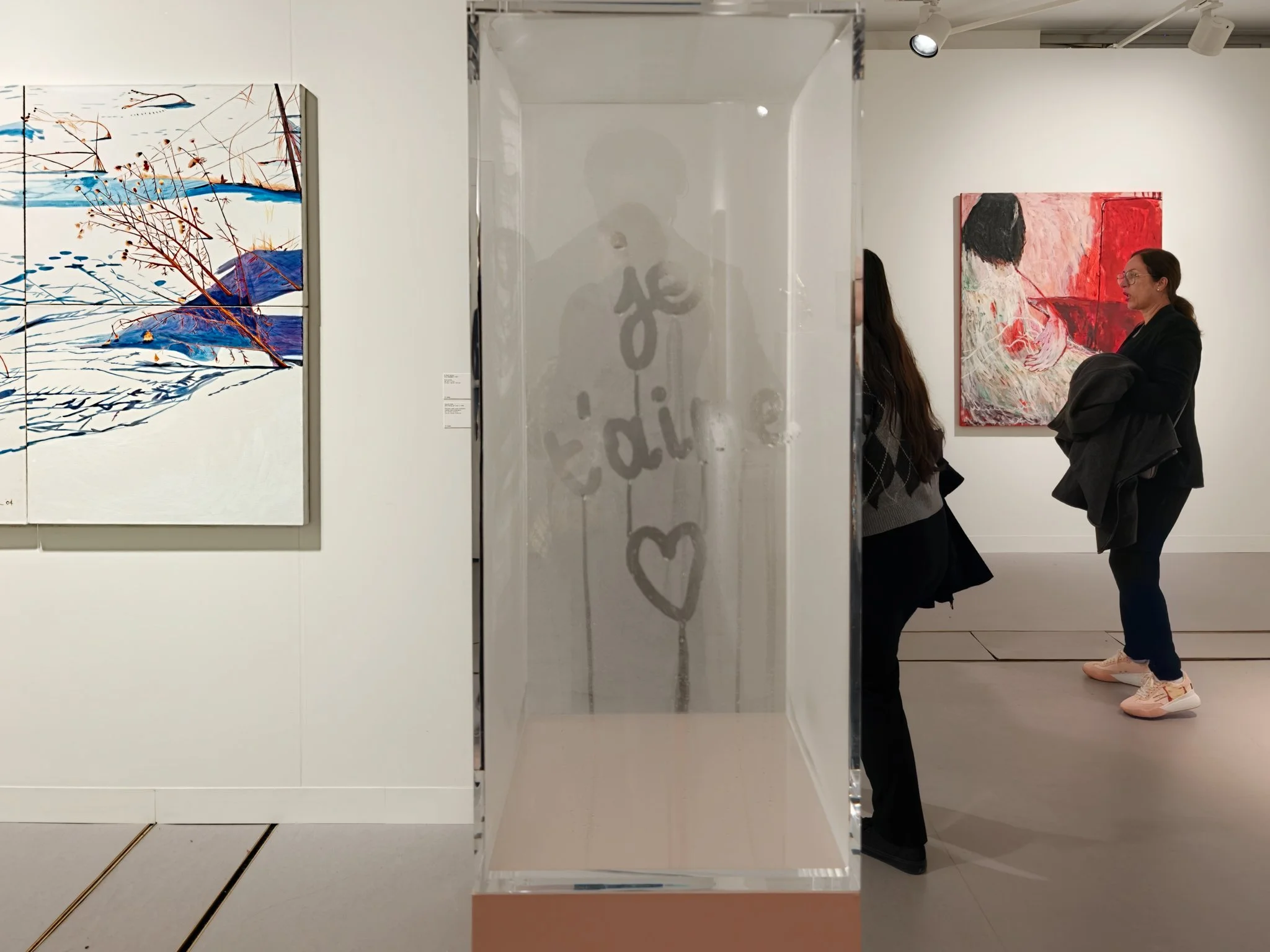
Antoine Catala, Mist Drawing (Je T’aime ♡), 2026 at 47 Canal. Plexiglas, water, wood, hydrophilic coating and water condensation, 170.18 × 34.93 × 34.93 cm. Image: Dan Latif.
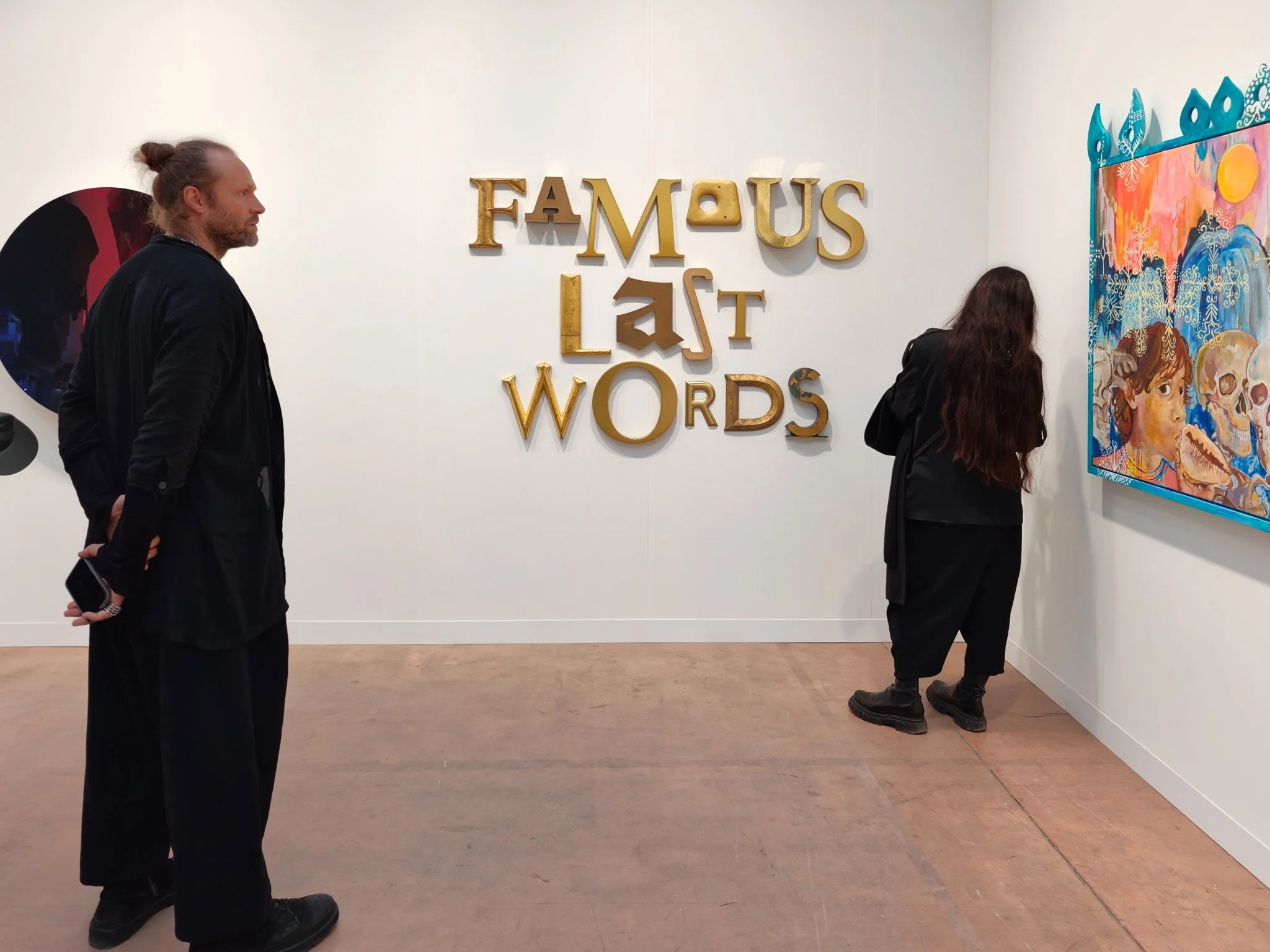
Jack Pierson, Famous Last Words, 2026. Metal and wood, 116.8 × 174.6 × 7 cm. Image: Dan Latif.
David Smalling's Muscle Memory (2026) at Art Basel Paris
At Templon, a painting by David Smalling catches the attention of a privileged few. Muscle Memory (2026) depicts a strange pink form with almost organic curves, adorned with a satin bow and strands of pearls, resting against the bell of a brass instrument. The delicate, somewhat enigmatic composition immediately sparks a debate. "I think the pink bow is incredible. There's a whole play on expectations of masculinity, and that's exactly why the pink is there," explains a gallerist. "But isn't pink the symbol of femininity?" a woman replies. "It's both masculine and feminine," another client declares, before a third confides, "My husband thought it was beautiful." Her neighbor concludes, amused, "Oh, so men like it? Well, I don't." Just a few words are enough to turn the contemplation of a painting into a spontaneous discussion, with everyone projecting their own tastes, references and contradictions onto the work.
How Visitors Experience Art at Art Basel Paris
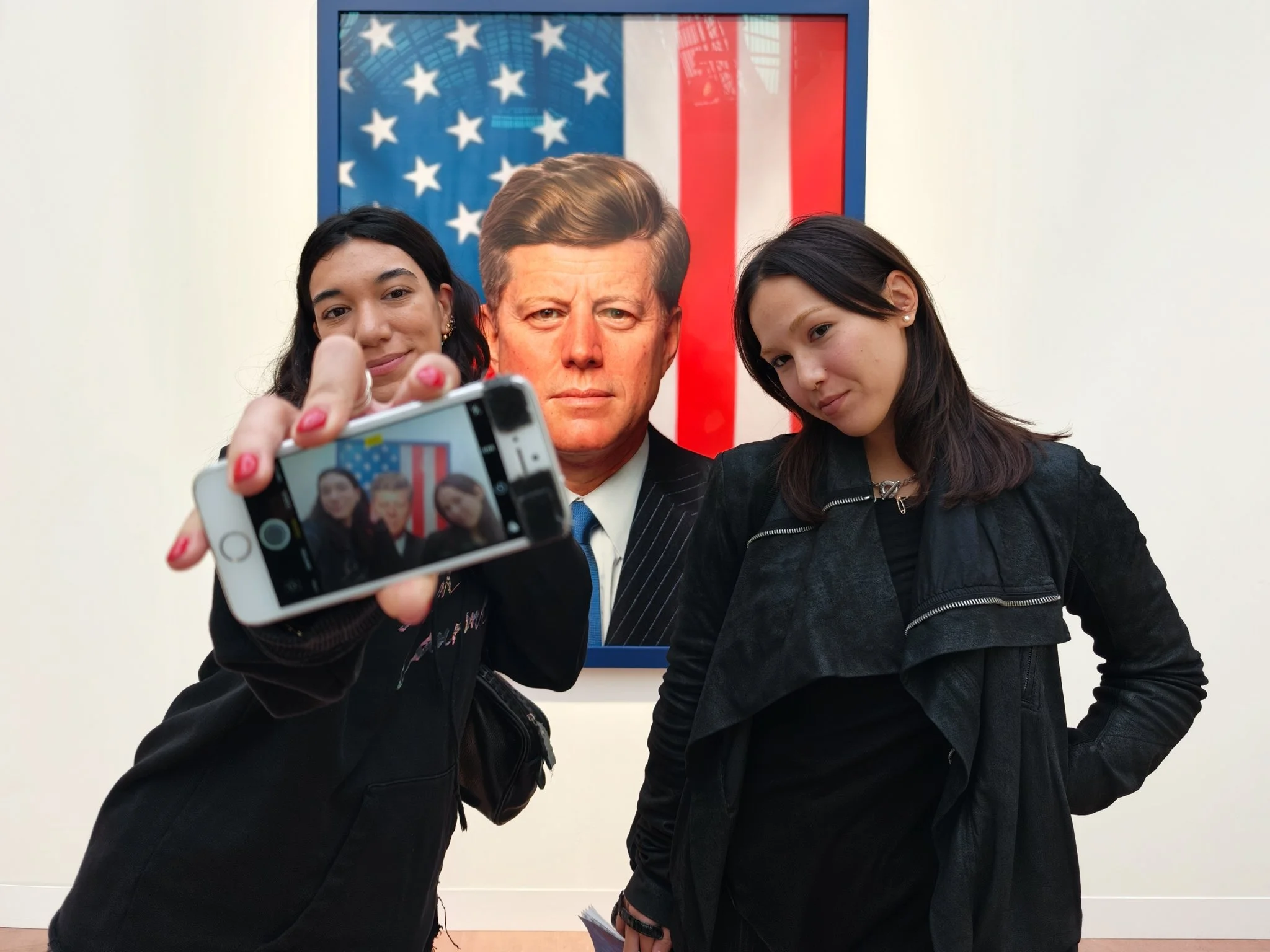
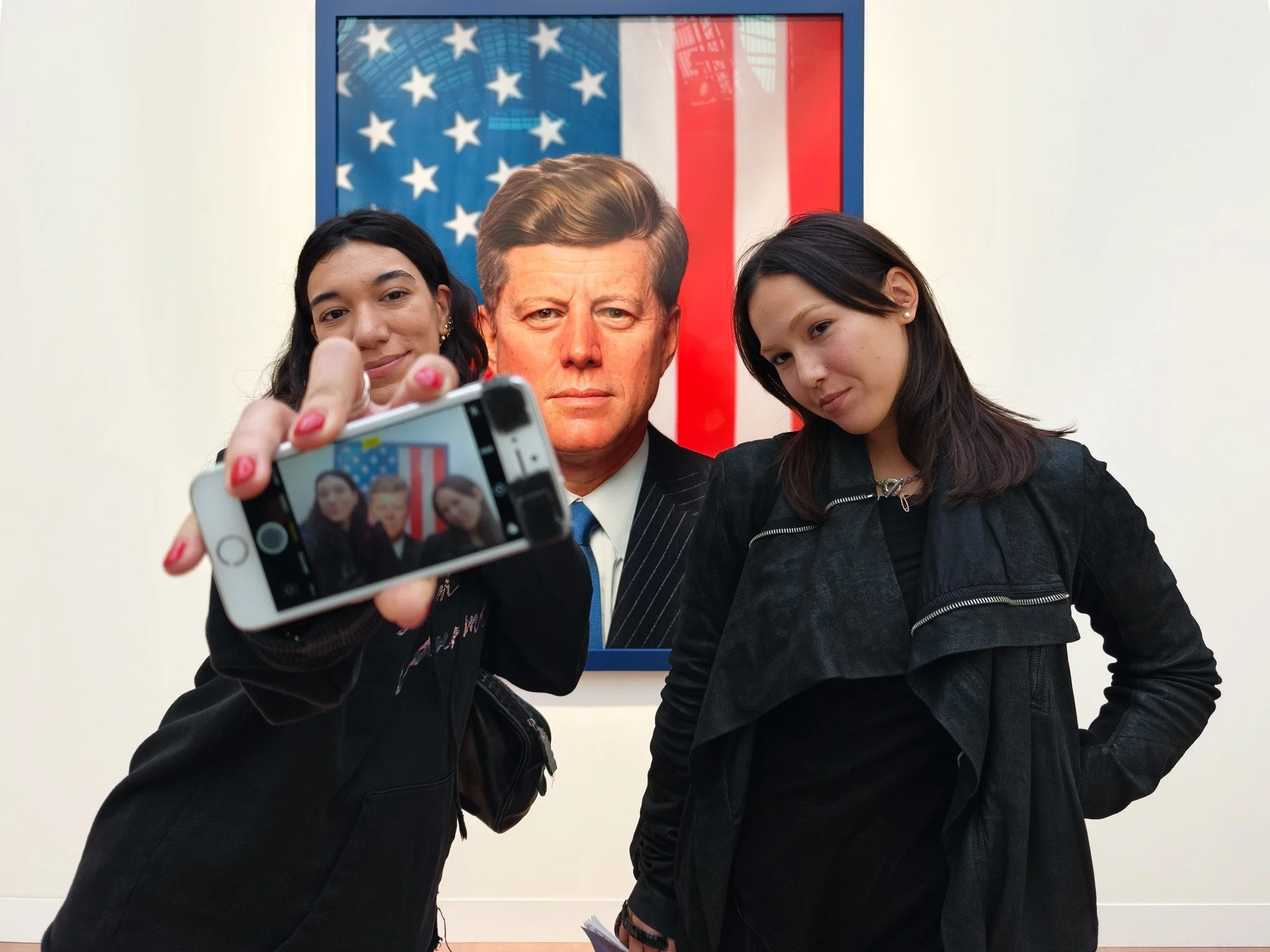
Gillian Wearing, Me as John F. Kennedy, 2026 at Tanya Bonakdar Gallery. Image: Dan Latif.
Turning into another aisle, we meet Valentina Bisco, a fashion stylist, and Tyra Galieva, an art director, who have just fallen for a portrait of John F. Kennedy, Gillian Wearing’s Me as John F. Kennedy. The striking realism of the former American president's face, depicted against the Stars and Stripes, makes a selfie irresistible. The two young women are covering Art Basel with an intention that goes beyond simply documenting the artworks. "We need to bring some fun back. Everything is going wrong in the world, so if we're taking pictures, it's about trying to be more present, to have fun and to be more spontaneous," explains Valentina, who wants to bring a little lightness back to social media. "It might not look like it, but we're actually working right now," Tyra jokes as they pose in front of Kennedy.
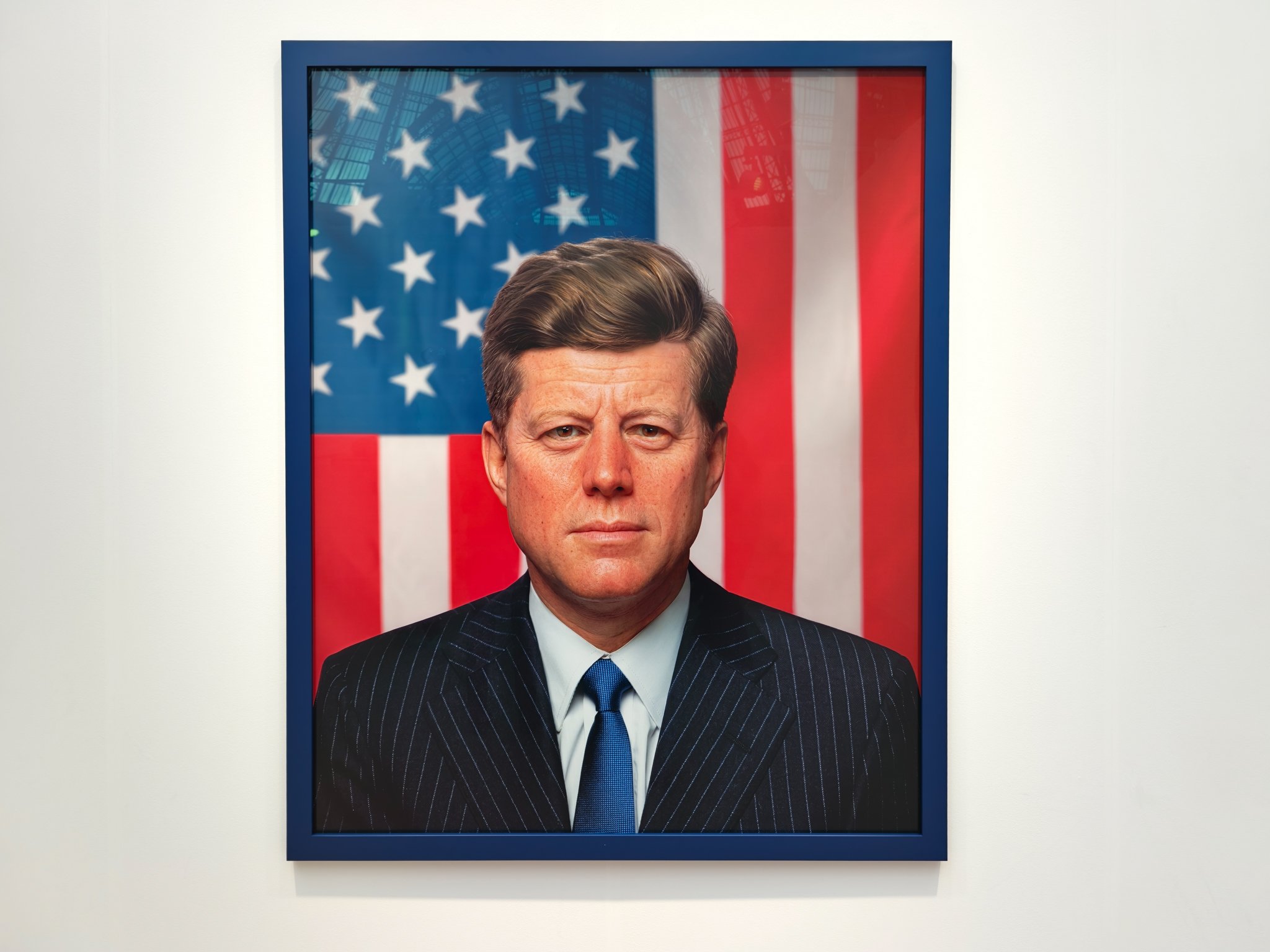
Gillian Wearing, Me as John F. Kennedy, 2026 at Tanya Bonakdar Gallery. Image: Dan Latif.
Throughout the aisles, photographs are being taken everywhere. Some visitors stop in front of a painting to preserve the memory; others photograph a work as they might a piece of furniture or an object discovered in an antique shop. "We take pictures of the objects and paintings we'd love to have at home, then come to terms with the fact that we'll never actually need them," confides Théophile de Lagarde, an antiques dealer who has come to browse the latest trends. Watching the visitors around him, he is amused by this new reflex: "We take pictures, and then we look at them."
Not everything, however, inspires the same admiration. There is also some rather questionable stuff, such as Catherine Christer Hennix's "found photographic images on paper", presented by Empty Gallery from Hong Kong. Found photographic images taken from adult magazines and presented as small framed collages. A proposition that stands apart from the monumental paintings and sophisticated installations, reminding us how widely aesthetic standards, artistic intentions and visitors' tastes can differ.
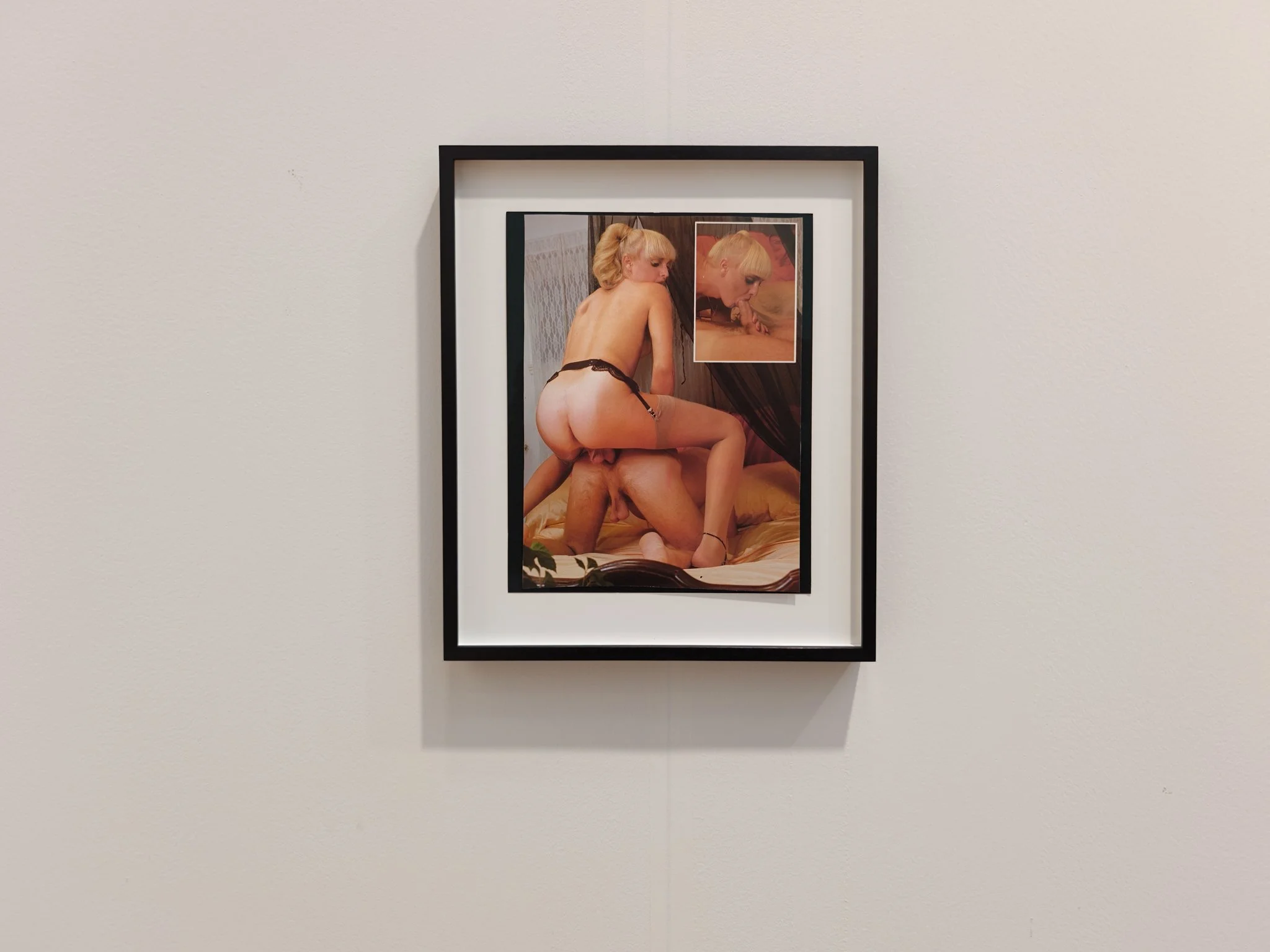
Catherine Christer Hennix, Untitled, ca. 1990 at Empty Gallery. Found photographic images on paper. Image: Dan Latif.
Artists at Art Basel Paris: Inspiration, Discovery, and Influence
Lisa Ouakil on Art Basel Paris
For artist Lisa Ouakil, visiting Art Basel is an opportunity to "get a sense of the tempo and discover artists we don't yet know." As she wanders through the aisles, she notices "a lot of color, and an energy that feels strange in contrast with everything we're experiencing in the world today." An impression that reflects the contrast between the fair's vibrant atmosphere and the mood beyond its walls. "It feels good to see art. It's calming, and it helps you see the light at the end of the tunnel," she confides.
Lisa Ouakil works across painting, public-space murals and ceramics, exploring the connections between bodies and landscapes, with particular attention to color and its vibration within space. Based at Iota Studio, which will hold an open studio day on November 7, 2026, she will also present her work at L'AiR ARTS Association in Paris's 15th arrondissement on December 5, 2026. Another way of approaching the fair, not simply as a commercial showcase, but as a place to experience an energy, discover new practices and nourish one's own artistic research.
Natacha Ivaldi on Art, Technology, and Picasso
Art Basel thus attracts prominent figures from the art world, collectors, newcomers, buyers, but also artists who have come to observe the work of their peers. Among them is Natacha Ivaldi a contemporary artist exploring harmony and symbiosis between technology and nature. Her work draws in particular on the aesthetics of printed circuit boards, whose networks of lines and connections represent, for her, "energy and life."
This relationship between art, science and technology echoes an unusual family history. Natacha speaks of her great-great-grandmother, Princess Vilma Lwoff-Parlaghy, a portrait painter whose subjects included Nikola Tesla, Theodore Roosevelt and Emperor Wilhelm II. The princess lived at New York's Plaza Hotel with a lion named Goldfleck, who was buried at Hartsdale Pet Cemetery in New York. A remarkable anecdote, much like this family history in which painting, historical celebrities and a fascination with scientific inventions intersect.
"I'm the next Picasso," Natacha declares with playful confidence. She has come to see what's new, discover opportunities and find her place in the art world. On her phone, she scrolls through photographs of her favourites: Miró, Anish Kapoor, Lucio Fontana and Daniel Buren. As the images appear, she realises with delight that she has photographed almost nothing but great masters or already well-established artists. Among the works that caught her attention is also a piece by Paulina Peavy, presented to her at a price of €230,000 by Emanuela Campoli, a gallery with locations in Paris and Milan.
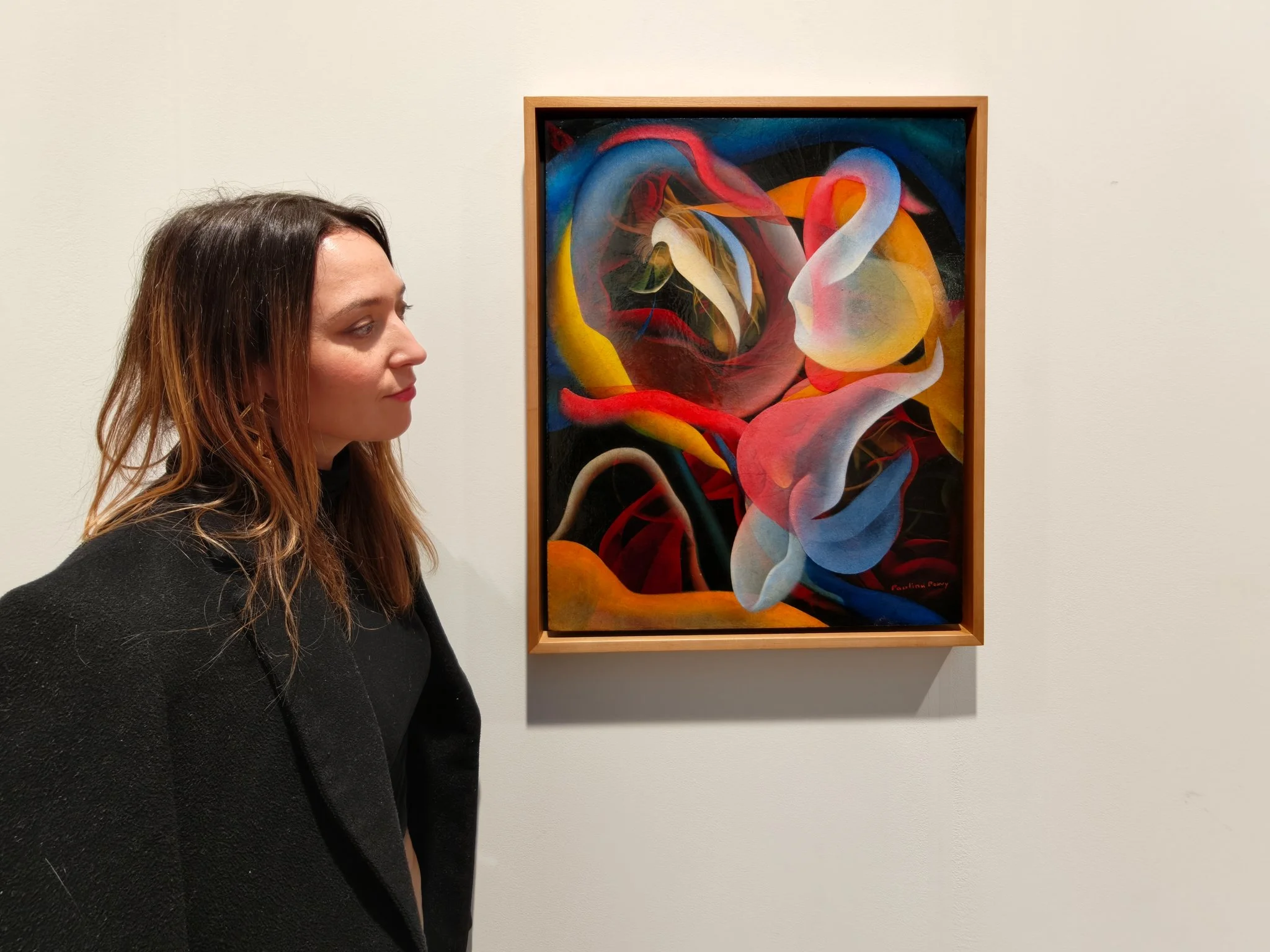
Paulina Peavy work at Emanuela Campoli. Image: Dan Latif.
Art Beyond the Galleries at the Grand Palais
At the Grand Palais, hardly any space goes to waste. Even a wall overlooking the staircase leading to the toilets has been taken over by Electricity, a graphic intervention by Luisa Kasalicky, created specifically for Art Basel 2026. A large composition of stylised figures outlined in black, punctuated by touches of yellow, red, blue and green, occupies this rather unexpected location. Undoubtedly one of the fair's most widely seen works, or at least one that visitors are almost certain to pass, whether they were looking for it or not.
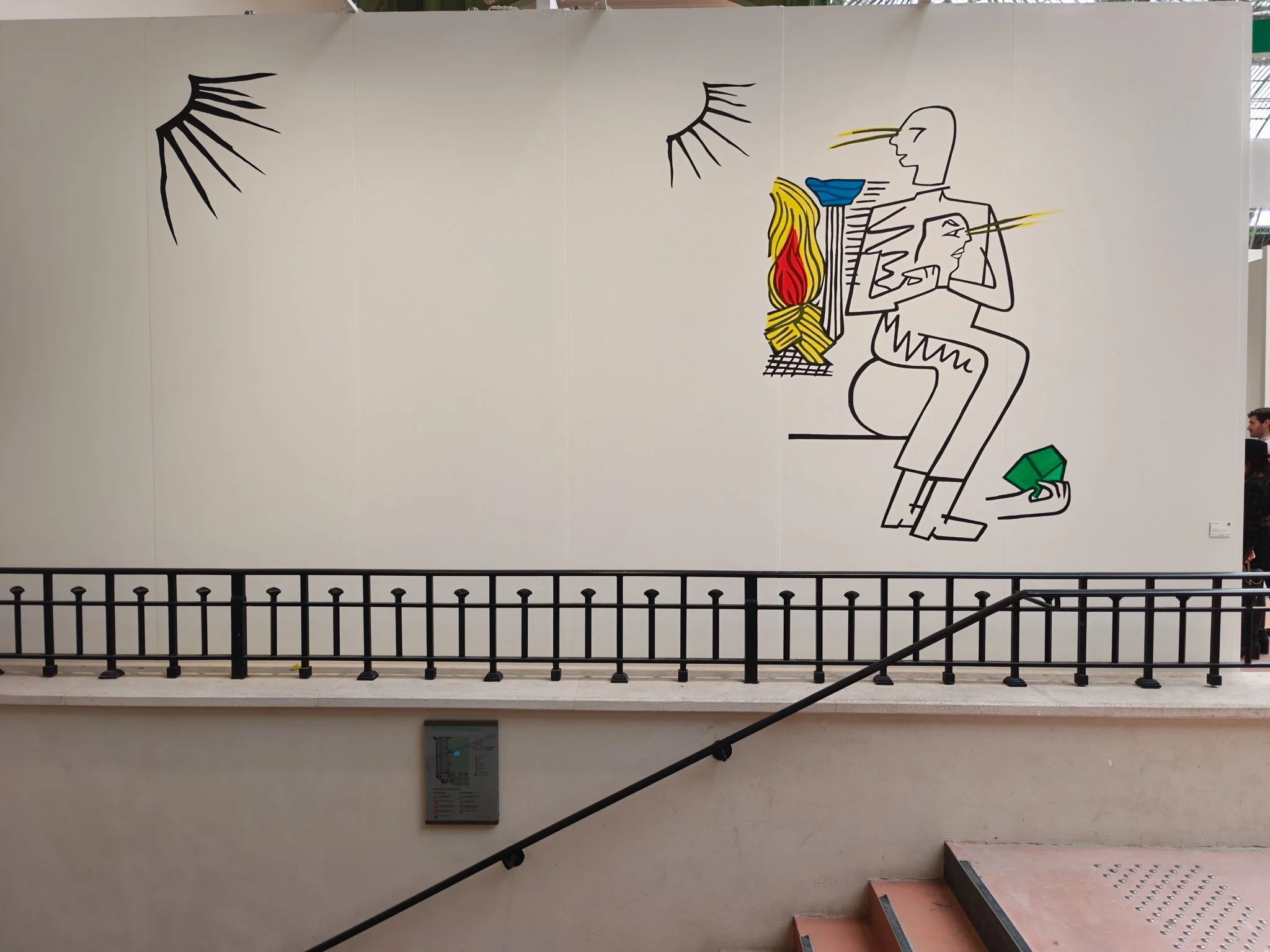
Luisa Kasalicky, Electricity, 2026 at Galerie nächst St. Stephan Rosemarie Schwarzwälder. Site-specific wall painting, approximately 300 × 575 cm. Image: Dan Latif.
The visit is drawing to a close, but the images continue to accumulate on phones. Hundreds of works seen, photographed, discussed, or sometimes merely glimpsed between two visitors or through a door left ajar. Some will be remembered for their size, others for a color, a phrase or an unexpected detail. Still others will retain that element of mystery peculiar to works concealed in storerooms, those that leave us wondering what they are worth, whom they are intended for and why they are not hanging on the walls.
Learn more about Art Basel here.



No more FOMO! These are the not-to-miss events during Miami Art Week 2025. From Es Devlin’s monumental Library of Us on Faena Beach to Jeffrey Deitch’s That Was Then, This Is Now in the Design District, New openings from Cartier, plus major presentations inside Art Basel Miami Beach and Art Miami. Many of these exhibitions run through the end of the year, offering the chance to experience Miami’s creative landscape long after the week’s rush subsides.