Meet the Swarovski Foundation’s Creatives for Our Future 2025 Finalists: Blossom Eromosele, Moemen Sobh, Barimah Asare, Mangesh Kurund, Azra Firmansyah, Aurélie Fontan
During a celebration at the United Nations, we sat down with the finalists in Swarovski Foundation’s Creatives for Our Future 2025 cohort, discussing everything from sustainable design, e-waste, and how place influences solutions.
UN Office for Partnerships and Swarovski Foundation have used their international presence to highlight what would otherwise be hard to hear messages from those who have personalized how they want to improve life. May we all be inspired to create positive change in the world the way these young inventors have.
Meet the Creatives for Our Future Finalists: Young Designers Creating Real Solutions

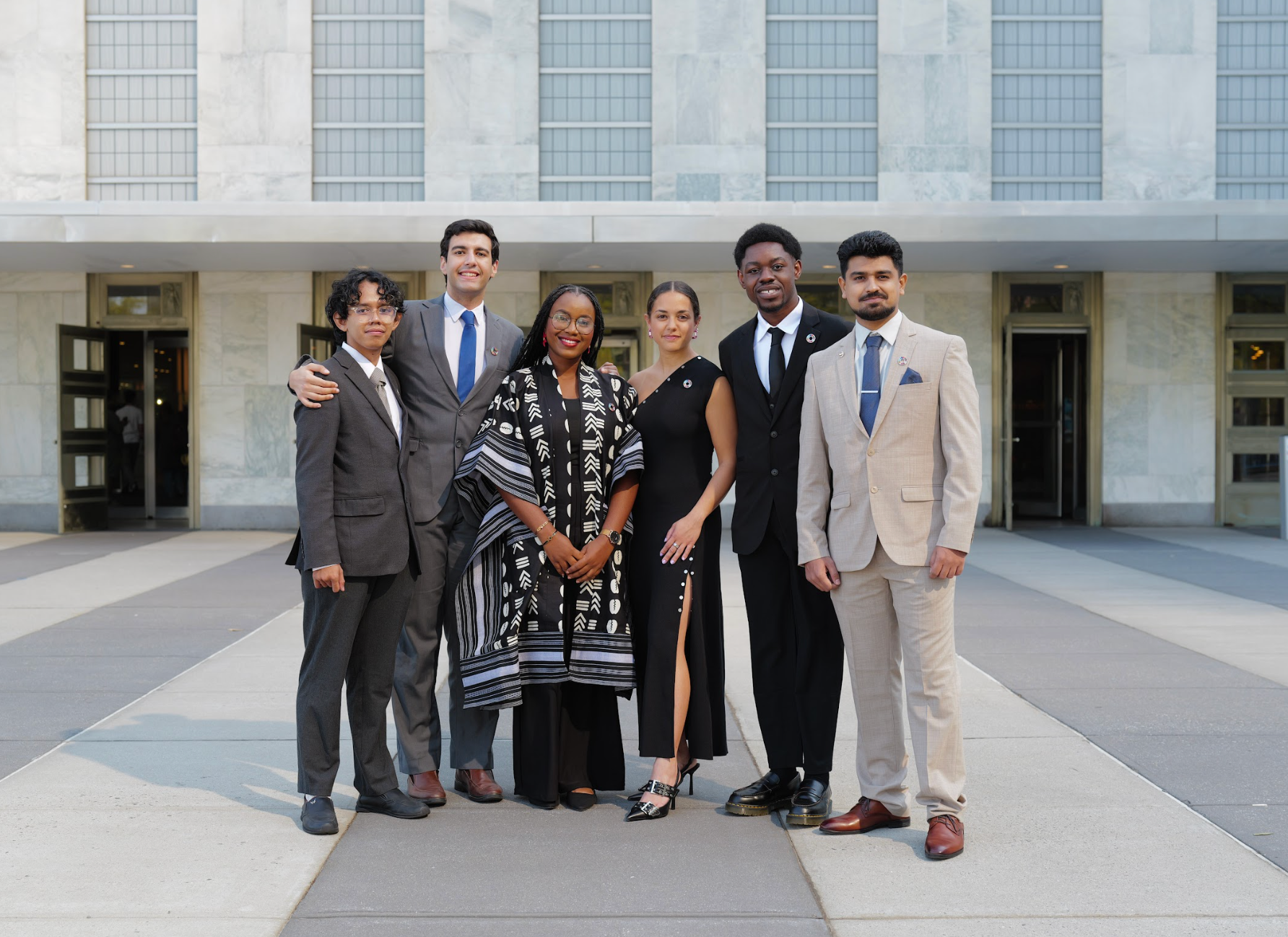
Azra Firmansyah, Moemen Sobh, Blossom Eromosele, Aurélie Fontan, Barimah Asare, and Mangesh Kurund attend Swarovski Foundation Creatives For Our Future 2025 on April 24, 2025 in New York City. Image: Dave Kotinsky via Getty Images for Swarovski.
“They’re all at the office,” I am told by someone official. Part of me wonders if I even need to meet them. Part of them is probably wondering if I even need to meet them. I already wrote everyone’s bios off of their bios. I scheduled interviews, but wasn’t sure of the schedule.
We meet.
Everyone flew into New York City Sunday. First stop? Central Park. Longest flight? Thirty four hours. They’re all staying the week at a hotel, but I wonder if those who are local to New York get to go home and take home the hotel credit, but I forgot to ask.
When it comes to honors, it can get jaded, thinking someone who knows someone who knows. My main take away after interviewing each honoree? Swarovski legitimately went through all 486 applicants, from over 60 countries, and chose six real people who’ve personally encountered real niche world problems and somehow created real solutions. Meeting them was a must. No bio would be more bio enough than speaking with them in person.
Interview with Blossom Eromosele, Nigeria

Blossom Eromosele. Image: Provided.
AllSpace Modular Home creates low-cost modular homes comprised of recycled materials and solar energy. With this grant, she will test prototypes in a refugee camp. She’s also a Young Global Changer Award, and Young Climate Prize Fellow.
The Interior Review: What was your moment of inspiration?
Blossom Eromosele: As a kid, I would see homeless people and think they just wanted to sit, but as I grew up I realized they weren’t sitting, they didn’t have anywhere to go. We didn’t have the best conditions growing up, but I learned a sense of safety. I want others to have that sense of safety. And hope.
The Interior Review: Did you always want to be an architect?

AllSpace Modular Homes. Image: Provided.
Blossom Eromosele: I wanted to do something about the housing crisis. During COVID, I visited an orphanage that was really run down. I didn’t have the funds, I didn’t know anyone, but I made a post, and shockingly a lot of people reached out, sponsors, volunteers. And suddenly I had a team, funds. When the project was complete, I thought, ‘I don’t need to sit on the sidelines. I can do this.’
The Interior Review: Any moments?
Blossom Eromosele: It would shock you just how much having one light bulb in a space can make a difference.
The Interior Review: Would you rather have a funny quote or a smart quote?
Blossom Eromosele: Both.
The Interior Review: Do you have one?
Blossom Eromosele: ‘Design so simply [that people think they could’ve done it themselves.’
Interview with Moemen Sobh, Egypt, Architect and Designer
Visenleer converts ocean waste into sustainable textiles usable for fashion, medical, and architectural purposes. With Swarovski Foundation’s Creatives for Our Future grant, he will train more fishermen in processing their waste into textiles, as well as scaling, with operations in Milan. Other awards include AFS Young Global Citizen Award and an award from the International Union for the Conservation of Nature.
The Interior Review: Moment of Inspiration?
Moemen Sobh: This kid emerged from the sea covered in waste, oil, and fish guts. Traumatizing.
The Interior Review: Was that normal?
Moemen Sobh: As a kid, I would swim by floating black bags filled with fishing waste.
The Interior Review: Are you related with the fishing industry?

Visenleer’s Raw Material. Image: Provided.
Moemen Sobh: Besides being an architect, I’m a fisherman by heart and a fisherman by profession. My parents, grandparents, great grandparents are fishermen. This is my heritage and culture. But within the past few years, sadly 25,000 fishermen lost their jobs in Egypt, and my parents were one of them.
The Interior Review: Were you ever expected to continue, or how did you transition into fashion?
Moemen Sobh: Port Said is where I grew up, popular for what I call the two F’s: fast fashion and fishing. Fast fashion produces a lot of waste, there’s an oil and gas industry, and all that gets dumped into the water. So it’s not surprising I combined fish and fashion, but surprising.
The Interior Review: How did you make the connection?
Moemen Sobh: One of the craziest things was going to a fisherman, “Can I buy your fish waste?” The fisherman was like, “You can take my waste for free.” But I insisted, “No, let me buy your waste,” that’s the catching point, to create and instill value in what they were doing. I dumped it all in the kitchen, and my mom was like, “What’s that smell!” And I started testing on it. But the tanning process has been around 200-300 years, just with the wrong chemicals. Our process is all organic with a focus on craftsmanship.
The Interior Review: Funny quote or smart quote?
Moemen Sobh: Funny.
The Interior Review: Quote?
Moemen Sobh: Oh gosh. ‘Period.’
The Interior Review: Period [laughs].
Moemen Sobh: ‘Waste is the gold of the 21st century.’
Interview with Barimah Asare, United States, Product Designer

Asare’s HiveMind prototype. Image: Provided.
Project HiveMind created a compact external card enclosure that can upgrade graphics of older laptops, thereby reducing e-waste. With Swarovski Foundation’s Creatives for Our Future grant, he will make this project market-ready. University of the Arts London has honored him one of the top fifty emerging innovators.
The Interior Review: Moment of Inspiration?
Barimah Asare: I couldn’t always get the best stuff [laughs]. Let’s say your game console breaks, how can I fix it? I can’t buy a new one. So I got to figure it out. Because I can’t not. As you evolve and grow, it can grow with you. It’s so much fun.
The Interior Review: What’s your thought process?
Barimah Asare: How can I help you do more stuff? Current options are traditional. But that’s surface level. Let’s go deeper, how can we advance that? People like to travel, let’s make it smaller, lighter. People are always going through these pain points. If we have the technology, let’s try it. What are we innovating for? If I can make someone’s day better, then I’m a happy man.
The Interior Review: Funny quote or smart quote?
Barimah Asare: Funny-smart quote.
The Interior Review: Do you have a quote?
Barimah Asare: ‘Do it to fail. You do it to fail, do it to fail, until you win.’
The Interior Review: How were you raised?
Barimah Asare: My mom is very caring. I’m definitely not like my mom… but then I notice people going through stuff, and I’m like, how can I help? I can’t turn it off. I guess it helps with the design. Open the conversation. Do as much as you can with the knowledge you have.
The Interior Review: Have you ever been stumped by anything? I feel like you’ve never been like “eh.”
Barimah Asare: But that’s the point. You shouldn’t know the answer to everything. You come to [Swarovski Foundation] and it’s wonderful, and you hear things that are amazing, but like, you don’t know. Not everyone is supposed to know everything, but that’s why we’re talking. You got to learn as much as you can. You gather people from across the world, great things happen.
Interview with Mangesh Kurund, India, Architect and Bio-Integrated Designer
Mangesh’s bio-clads create bio-receptive (living material) cladding (weather proof) system material that will do for man-made buildings, what trees do for the air: purify and cool. With the grant from Swarovski Foundation, he will test his prototypes in the real world.
The Interior Review: When you tell people you do bio-cladding, what’s their reaction?

Mangesh Kurund: "Oh, you work with fungi! Oh, you work with algae? Oh, you work with mosses? Doesn’t that actually create a problem?” But, there’s actually a lot of positive effects that get under looked, ill treated, such as heat remediation and air purification. These species thrive in such difficult conditions, and cleanse the surroundings for you, and yet they are ignored because of their aesthetics. There’s a lack of vision that designers have a responsibility to share with the world.
The Interior Review: Moment of Inspiration?
Mangesh Kurund: I come from a farming family. Whenever I go to cities, I wondered why aren’t cities more part of nature?
The Interior Review: Were you meant to go into farming?
Mangesh Kurund: My dad was the first generation to go to school. I’m the second generation, went to school in Mumbai, but grew up around agriculture because of my family background.
The Interior Review: Funny Quote or Smart Quote?
Mangesh Kurund: Being funny is quite relevant to being smart. Smart in a funny way.
The Interior Review: Quote?
Mangesh Kurund: ‘Today the building, less the plant. Tomorrow the plant, less the building.’
Interview with Azra Firmansyah, Indonesia, Product Designer
Firmansyah’s project Svaika allows deaf individuals to touch music using a wearable forearm device, celebrating this community's unique experience of this world. With Swarovski Foundation’s Creatives for Our Future grant, he will test his products with those directly affected: Indonesia’s deaf community.

Azra Firmansyah. Image: Provided.
The Interior Review: Why the connection between this device with the deaf community and not another language?
Azra Firmansyah: My friend who likes to enjoy music feels his music. I sort of assumed it would be classical, slow and calm, but the funny thing is, he enjoys hip hop. And that fascinates me. He has a really big speaker, he would place his hands on it, and feel the dun-dun-chnn. The way of living for deaf people is really, really unique. They have their own microcosm, and with my project, I hope to increase funding, innovating, and supporting the already established culture of the deaf community.
The Interior Review: Your language when describing the deaf community is very specific. Do you have a connection?
Azra Firmansyah: When I took sign language classes, I became friends with my classmates, teachers, and they taught me so much about what they have to go through. Deaf people have their own unique understanding of the world that’s different than ours, but doesn’t mean it needs to change to fit ours.
The Interior Review: You’re a product designer, but learning languages is purely your hobby?
Azra Firmansyah: I love learning languages because it helps me understand the perspective and experiences people may only feel comfortable sharing in their own language. Even when I speak English, I feel more expressive and direct. I know Swedish, French, Chinese, Arabic, ASL, Indonesian SL…
The Interior Review: Is language conducive to culture?
Azra Firmansyah: You cannot have language without culture. Language is formed from the habits of the culture.
The Interior Review: Do you have a quote you use during your process?
Azra Firmansyah: ‘If you’re scared of doing it, then do it scared. I’m doing it scared right now.’
The Interior Review: You’re doing it great.
Interview with Aurélie Fontan, United Kingdom, Fashion Designer
Regen Ink creates toxic-free and sustainable textile dyes by regenerating unusable polluted land. With Swarovski Foundation’s Creatives for Our Future grant, she will further refine her textile print paste to commercial and industry standards, testing with a fashion brand. Among others, Julia Fox has notably worn her designs.

Aurélie Fontan’s Regen Ink. Image: Provided.
The Interior Review: How did you come up with the idea?
Aurélie Fontan: Phytomining. Plant mining. Most plants can absorb heavy metals in the soil. Some people in electronic sector use these plants, and burn them to extract the rare earth and minerals. Can we do the same thing with fashion? When you use natural fibers, you need a metal vector for the dyes to stay. Is there a two-in-one, where the plants are mining it themselves? It’s called phytoremediation.
The Interior Review: How did you even come across that concept?
Aurélie Fontan: I do a lot of research on mushrooms and plants. It’s nice to use natural things, but how do we use them? Nature is so smart, it does things really well, there’s no concept of waste. Mushrooms and plants absorb pollution. They can absorb plastic and turn it into something biodegradable.
The Interior Review: Did you know you always wanted to get into fashion?
Aurélie Fontan: My great great great grandmother had an embroidery atelier in Paris and she was working for Chanel. I’m also embroidering my dresses and things, so it runs in my family, but we kind of lost that heritage. I started as a regular fashion person, and then got into biology and science.
The Interior Review: Funny quote or smart quote?
Aurélie Fontan: My project is very much about science, so I guess a smart quote
The Interior Review: Do you have quote?
Aurélie Fontan: “Fashion needs to get ready to enter the bio revolution.”
Learn more about the Swarovski Foundation here. Learn more about Swarovski Foundation’s collaboration with United Nations Office for Partnerships here. Learn more about Creatives for Our Future application details and deadlines here.





The Swarovski Foundation and the United Nations gathered to celebrate a new class of young global changemakers—offering funding, mentorship, and a spotlight on creativity as a force for sustainable impact.